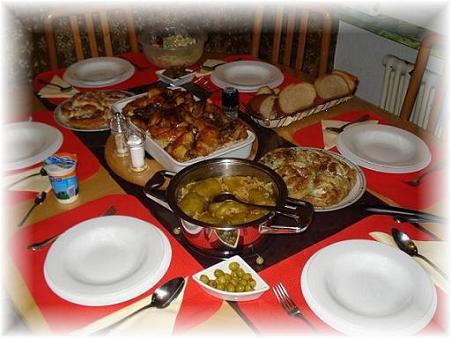
Aug 26, 2013

PEKSIMETI


Ingredients

1 kg flour

500 ml  yoghurt

2 eggs

12 g dried yeast

500 ml water, salt, oil


Stir salt and yeast into flour; add eggs and yoghurt.

Stir while gradually adding water.

The dough should be solid but wet and sticky to touch.

Spread some flour onto a chopping board and put dough on it.

Cover the dough in flour so that it does not stick to your fingers while you cut it into finger shaped pieces (size: 4x4x15cm roughly).

Fry the dough fingers in oil until golden brown and serve immediately with a selection of mild cheeses and dips.


Aug 20, 2013

Flowers that smell like sorrow

Bosnian lily (Lilium bosniacum) is a flower of Bosnia and Bosnian people. Extraordinarily beautiful flower, dignified, all in golden-yellow color it proudly keeps its loftiness and regal posture  while its red stamen symbolize blood of the Bosnian man, which was often shed because of the enemies of this country. The Bosnian lily became a symbol for the suffering of Bosnian people during the aggression on Bosnia and Herzegovina from 1992 to 1995. In a tragic song it is mentioned that a lily each year on July 11th changes its fragrance and that day it smells like sorrow and pain. That day from the lily the blood drips on the sacred Bosnian land on which the dead bodies of murdered men, women and children of Srebrenica, Sarajevo, Žepa, Zvornik, Bijeljina, Foča, Višegrad, Prijedor, etc. lay.


Jul 18, 2013

How to steal a birthmark from someone's face?

A birthmark in Bosnia has always been considered a pretty accessory on the body, especially if it was located on a face of a woman. Located near the eyes, the birthmark would make the woman prettier and more attractive and gave her a note of mysticism. In the case of numerous birthmarks on the face or one large birthmark located on the nose or the chin, then it created an opposite effect and made the woman uglier and unattractive.


Since the old times, birthmarks were given magical properties and it was believed that a person born with a birthmark, especially the one with red colour, has an immunity on the effects of black magic. Besides being a blessing , the birthmark can also be a sign of god's punishment for sins. Namely, if the pregnant woman steals something, it is believed that it will be revealed once the baby is born since on the part of the body which she touched after the theft a birthmark will be present on the baby's body at the exact same spot.
 
A small dark birthmark was since the old days a coveted accessory, especially on the right cheek of a woman. That's why a large number of pregnant women use the state that they are in to steal something small and black from the house that they visit, in order for her child, especially if it is a female, to have the coveted beauty mark on her face. Usually a grain of pepper was chosen as the object that the pregnant woman would steal since it resembled the beauty mark. Immediately after stealing the grain, the pregnant woman would touch her right cheek, close to her eye.
 
Besides appearing as a form of punishment or intervention of a pregnant woman, the birthmark can also appear on the body as a result of someone's ill intent towards him/her. When a pregnant woman visits a house, her baby is in danger of falling prey to a magic ritual. While the pregnant woman is walking away from the house, a person that wishes ill intent towards her future child, takes a hot coal and throws it after the pregnant woman, without her noticing it, and touches a party of body that he wants the baby to have a nasty birthmark.
 
According to folk belief a birthmark can be stolen from someone's face?! We're not talking about a plain theft but one done with the help of magic. The conditions for performing this spell are simple, it is necessary for the person whose birthmark one wants to steal to be asleep. The thief takes a warm piece of bread, brakes it in half and brings it close to the birthmark so that the vapour from the fresh bread can cover the birthmark. One needs to hold the bread in place for several minutes close to the face taking care not to wake the individual. If the person wakes up the ritual will fail. However if it succeeds the person eats that bread and soon the birthmark will appear on their face and disappear from the face of the victim. After that, it is believed that the person which had their birthmark stolen will die shortly after the ritual, that's why this ritual was always criticized and classified as a ritual of banned black magic.   

Jul 15, 2013

THE GARDEN OF HAZRAT HAVA

The use of herbs for medicinal purposes is the oldest form of medicine. The cognition about the medical properties of individual herbs the Bosnian people reached through an empirical method, following particular animals, such as cats and dogs, which would eat an herb when they were sick or injured. In the same manner, humans would use a homeopathic method to compare the shape and colour of a plant with that of a human organ and based on that they reached a conclusion that since the plant corresponds to the organ it must have a positive effect on it.
The knowledge about medical and magic potential of herbs was revealed to individuals by faeries, as the legends claim. Dozens of folk songs speak about the verses that the faeries would utter in order to reveal the medical power of individual herbs. Besides that, one would come across information through magical rituals. One of them is the one of Illyrian descent when one would catch and kill a snake inside a forest and roast her until she turned into ash. That ash would be collected and gathered inside a glass. A person would take that glass and go to the part of the forest where the roosters and human voices couldn't be heard and would place some of that ash under his tongue. Apparently, at that moment the senses of that person would sharpen and that person would be connected with the nature bringing his consciousness in a state of trance. At that moment the person could hear and understand the voices of plants and trees around him and communicate with them.

 
Since the woman received the role of a mother and someone who takes care of the health of the children and family, from the old days, it is then logical that female deities were more present in those parts of healing where divine power and strength were called forth. When we analyze the list of medicinal herbs we can easily see that most names have a female connotation, which is another verification of the interconnectedness of the female sex and the plant world.
 
This connection can be seen in the short formula which is still today uttered by numerous stravarke while picking herbs which they intend on using as a magical item or an instrument for concocting a tea or medicine. While picking a specific plant the stravarka utters this formula which is followed by a rhyme in its original form: "I cull this plant from the garden of hazreti Hava (Eve), so that it can be a medicine and of benefit to me as it was to her." As we see from the above in herbal treatments the magic of words is inseparable from the process, the magic is constructed out of formulas of a short content called basme and formulas of a longer content called bajalice. Both of them are a key
component of the magical medicine in whose medicine the rhetorical power of the word is stressed.
 
Also in love magic a lot of attention is given to the use of specific herbs for which it is known to be a medicine for a "frozen heart". According to the rules of Bosnian witchcraft it is specifically culled between sunsets until midnight, on the eve of Friday, during the new moon.


An ideal example of such practice is the culling of milogled (asarurn europaeum) for whom there is a rule that it can be dug inside a forest with bloody hands on the first Friday of the new moon. Second powerful love herb is the mysterious "fairy grass" (Seseli rigidum?) which can only be found if you place a silver coin on the ground next to a spring. After that a witch would step aside and wait in hiding until the curious faeries show up drawn by the shinny object. At the place where they show up, after they have satisfied their curiosity regarding the silver coin they disappear, one should dig there since the root of fairy grass can be found there. Both roots should be carried on one's naked chest.

fairy grass

 
Herbs for magic but also for healing is infrequently grown in the gardens if the witches since they believe that the largest magic capacity can be found in "wild" grown (from God) plants especially if it grows in hard to reach places next to a river or a creek. Particularly amazing power is possessed by forest herbs, especially if there is a creek flowing through the forest. In the old Bosnian legends the faeries live inside the forests, and among them the famous Bosnian fairy, with whose song and dance all of the vegetation swells and grows and in special cycles it gains magical powers.

Jul 9, 2013

Ramadan in Bosnia - Ramazan u Bosni


The most important celebratory, ritualized occasions in Bosnia and Herzegovina are Ramadan (Ramazan), Eid al-Fitr (Ramazanski Bajram), and Eid al-Adha (Kurbanski Bajram). These occasions are commemorated with tables overflowing with carefully prepared, often special foods.


Ramadan, the monthlong Muslim fast, is the major event in the Bosniaks (Bošnjaci) ritual calendar. Believers do not eat, drink, smoke, or have sex between sunrise and sunset. Families wake while it is still dark and eat a larger-than-usual breakfest, often including types of dishes served at midday and evening meals. Their evening meals also consist of more dishes than usual and often include dessert, which is not part of everyday meals. Ramadan is a period of intense devotional activity centered in the mosque and with much socializing in homes in the evenings. The evening meals, which break the day's fast, for example, are often shared with friends and neighbors. Eid al-Fitr is the celebration of the end of Ramadan, and Eid al-Adha is the commemoration, 40 days after Ramadan, of the saving of Abraham's (Ibrahim) son  through the sacrifice of a lamb instead.


SEHUR AND IFTAR


Bosniaks would say prayer together during the day and then invite one another to their homes for iftar meals.
 
 
During Ramadan, Bosnians honour takvim, a fasting period between prayers at dawn and sunset (from sehur – brekfast, to iftar – dinner, or better yet, from sabah – dawn, to akšam – sunset). As the Bosnians often say „You sehur at sabah“ – you have breakfast at dawn.
 

Jun 30, 2013

Magical Plants of Bosnia and Herzegovina

The unbreakable bond of man and nature is best explained with one Bogomil legend. Sine God created man out of earth, he left him to dry in the sun and went to get the soul which will breathe life into the earthen body. Seeing the earthen creature, the devil used the moment of gods absence to poke 41 holes in the body and escaping. When god returned and blew the soul through the nostrils it went out through the holes that the devil poked. At that moment realising what kind of prank the devil played, he healed all the holes with the help of herbs, except one hole. This hole was determined for the soul's exit after death. Giving life to the human, god explained which herbs he placed inside his body, and in that sense revealing to him which herb heals which part of the body. That's why in folk medicine in BIH this number was always taken to set how long a certain tea needs to be consumed, how long to apply an ointment or something similar.
 
How much the Bogomil tradition was influential in traditional medicine is confirmed by the following recipe for various diseases. One would pick 40 types of herbs and store them in an earthen pot which would be filled with clean spring water. The pot would be sealed shut and buried to stay there for 40 days. After that the water from the pot would have to be drunk during 40 days since it was considered to be a panacea or medicine for all afflictions. According to traditional instructions, each morning on an empty stomach one would drink an amount of mixture that could fit in a small fildžan (traditional coffee cup).
 
Verem (Calamintha officinalis) - this Bosnian name for this plant comes from a Turkish word for sorrow and is traditionally used for treating the disease behind which lies depression.


Verem was used to make tea which was drunk by people who felt sorrow or melancholy. Especially susceptible to depression in the past were women of various age to whom it was suggested to drink tea from Verem and to go to a creek or river every day and dragging a cloth across the surface of the water to utter: "O dear water if you only knew how I felt" she would confide to the water and listen to the calming sound which would psychologically calm and relax them.
 
Stravna trava (Glechoma hederacea) in the ritual of fear elimination or another type of shock which appeared after a traumatic experience this plant was used. Stravarke, traditional Bosnian healers, boiled it in a vessel with water sometimes adding pieces of bread. When the water started to boil stravarka would, holding an empty pan, pour the boiling water above the head of the diseased into this pan along with the plant and she would flip that vessel upside down to create a vacuum in order for the fluids to return into the vessel. After the water cooled the diseased person would use it to wash his face and to drink it and the rest was thrown outside usually on the road or a cross road.


Still today most Bosnian herb healers are familiar with the effects of Stravna herb which in combination with time yields amazing results in depression treatment, treating anxiety and stress. According to the recipe of Ajla Jusupović from Foča a pinch of Verem and Strava herb is used and poured over with hot water. The vessel is covered and left to stand there for half an hour until it cools. The tea should be drunk three times a day, sweetened with honey.
 
Holly herbs of Bosnian paganism
 
Visibaba (Galanthus) since ancient times among the Bosnian folk this herb is named Baba or Grandma which alluded to dedication of this spring herb to the old deity Baba or old lady, ancient mother goddess. In the preserved writings of Bosnian ritual witchcraft this herb was used to remove sleepiness and spring fatigue from men, especially children. A stem of snowdrop (visibaba) would be circled three times around a person's head, clockwise, uttering " Snowdrop is sleeping and you're not, snowdrop is sad and you're happy!".
 
 
Baba or Grandma (Galanthus)
 
 
Heavenly husband and Baba's retainer is Did or old man, ancient sun god, to whom a plant has been dedicated in the south-western part of Bosnia by the name of Did or Silymarin. The plant was tabooed and holly which proves the folk belief that it shouldn't be trampled. The one who does so, will befall an accident.    
 
 
Did (Silymarin)


Jun 16, 2013

Mujo Hrnjica


                                              Dear God, who was that hero?
                                             It was Mujo Hrnjica of Kladuša.


Even though Mujo Hrnjica is not a mythological character but a real, historical figure, his life is interwoven from beginning to the end with a lot of mystical content which makes him an interesting figure about which one can write a lot.


What Hercules was for the ancient world Mujo Hrnjica is for the Bosnian world. Symbol of courage, a hero of great strength and a dangerous enemy to those that dislike his people. Because of all of those characteristics many Bosnian women named their son's Mujo which was a symbol of great strength and might and it contained prophylactic power against evil and disease.  
  
Historical tradition about Mujo begun in the fall of 1637 when Mujo's uncle Hurem-aga Kozlica brought his two young nephews, who lost their father in the war, from Udbina to Velika Kladuša. The older boy was called Mustafa, but he was called Mujo and the younger one Halil. Besides being younger, Halil was thinner and less bulky during childhood, since his mother couldn't breast feed him because of the great grief she felt for her killed husband, and Halil didn't accept milk from any other woman. That's why they fed him with cow's and goat's milk which brought him the name Stalled Halil or Ugojeni Halil.
 
According to legend, in Velika Kladuša Mujo and Halil were met by a mountain faery (Gorska vila), calling them with a song in early dawn. She brought them to the river Kladušnica, washed them with dew and fed them with faery milk. Halil didn't want to drink milk, he drank the dew instead while Mujo liked the faery milk very much and drank a lot of it. Because Halil took the dew from the faery he grew into a very handsome young man, all the girls in Velika Kladuša yearned for him, calling him and falling into hysteria once they saw him, Unlike him, Mujo gained enormous physical strength which was given to him by the faery milk. He had a stern and piercing gaze, the one possessed by warriors.


In that sense the mountain faery became the second mother to the future heroes who protected Kladuša fort from the enemy. It is interesting to note that the faeries were mentioned as messengers in songs which transferred news from one warrior to the other and helped defeat the enemies or to explain their tricks and ambushes. How popular the faery cult was is best witnessed by the medieval city Vrnograč, 16 km away from Velika Kladuša, which was according to legend built by faeries. That's why it is called faery town.


Vrnograč -  fairy town
 
 
The tradition about Mujo and the faeries is nothing more than an old Illyrian legend since Mujo's physical appearance is that of a warrior; he's tall, has thick dark hair, a moustache and a beard and strong arms. It's no coincidence that faeries are traditionally tied to Mujo since sine in the Illyrian times the cult of warrior was cherished which was closely associated with the cult of deities, especially the main one Vidasus among whom water nymphs were depicted i.e. faeries. In epic poems numerous encounters of Mujo and the faeries is mentioned, where they communicate and where the faeries heal Mujo's wounds gained in battle. How familiar he is with the faery world, their capabilities and character is best depicted in a poem in which Mujo like a skilled wizard manages to outwit the faeries transformed into goats.
 
According to legend, Mujo Hrnjica always carried an amulet with him on the right side of his suit. The amulet wasn't Islamic in content like the famous amulet-shirt of captain Husien Gradaščević, but ancient which stems from the cult of mother earth. It's a small red bag which contained 9 wheat kernels.

Wheat as one of the largest gifts of nature is a symbol of the cult of mother goddess, to whom faeries belong. All of this data confirms that among the Bosnian folk, through long continuity, the ancient tradition and beliefs were preserved. As the legend tells, the enemies found out what was protecting Mujo from death, through venal servants the enemies got a hold of Mujo's amulet. Apparently, the amulet was stolen a day before he was killed.


Mujo Hrnjica is the most famous hero along with Alija Đerzelez of Bosnian epic poems. The epic Mujo Hrnjica was presented to the wider literary and cultural audience in a striking manner by Kosta Hormann in his first and second journal. There the epic character is best presented in his ethical and psychological wholeness. Poems from these journals were recorded throughout Bosnia and Herzegovina and as such present the best proof of how famous and meaningful this grand hero was. Besides Mujo, his brother Halil is often mentioned, while stories about their third brother Omer are few.


On this rock which is called Ploča, which is a folk name for a horse shoe, according to legend the imprint of Mujo's horse Đogat can be seen which was made when they were passing through. The rock is located in Mala Kladuša above the main road between Velika Kladuša and Bihać.


 The city in which Mujo Hrnjica lived with his family - old town in Velika Kladuša. According to the reports of Krsto Frankopan Tržački to the archduke in Graz from 20.11.1641. "Mujo lives in Velika Kladuša with his brothers".


Mujo died between 1633-1676, he was betrayed and murdered by his fake friend Meho Katarica, who had just been converted to Islam.
 
Halil Hrnjica died in Banja Luka during a coupe, during which the famous Tale Ličanin died as well.
 
Omer was ambushed and killed by a chieftain (a leader of outlaws and bandits).     

Jun 3, 2013

Evil Eye

In Bosnia the effect of spellbound eyes is called urok, this name stems from the Illyrians and represents "captivation" or "fascination". The negative effect of the human gaze, according to belief, is mostly demonstrated in small children, especially in the first months of their life. That's why, in order to protect the small child a red, black or green string is tied around its wrist, in order to divert the first and most harmful gaze and in such a way to neuter the power of spellbound eyes.


The use of red string and tying knots on it while repeating specific chants is a traditional form of white magic which can be seen all around Bosnia. Usually older women practice this form of magic since they are the ones that believe in the effect of spellbound eyes the most. One of them is Fatima Dautović from Velika Kladuša, for quite some time she used to tie 99 knots on a black thread 40cm long. Before every bind she utters the verse Ayetul Kursi, blows into the string and strengthens the knot. This technique first of all requires calmness, concentration and time. When she finished tying all of the knots, the string is then wrapped around a small piece of yew (Taxus) tree in order to enhance its apotropaic power. An amulet constructed using this technique will protect the wearer from black magic, spellbound eyes, bad luck during travel. According to Fatima, if this amulet is worn by married women, they will be more dominant in marriage.

Ziba Kovačević from Zenica also practices an identical method of amulet construction against spellbound eyes, the only difference is that she uses red thread and ties 41 knots. The thread with the knots is wrapped around a small piece of yew tree. An amulet constructed in such a way is often wrapped around a child's hand.

-Yew is a tree that protects against evil and it is advisable that everyone carries a piece of it with them, in their pocket or wallet, Ziba explains.

It is also believed that the thread used to stitch the cloth used to wrap a dead person, gains prophylactic powers. A thread of 10 cm is used and once it has been threaded through the cloth, it is then divided into two equal parts. The first part of the thread is thrown in a whirlpool of a river and the other half is used to tie a knot and is carried alongside the user. Allegedly such a knot protects against all forms of evil, spellbound eyes and black magic.
 

There are various forms of spellbound eyes that are known among the Bosnian folk:

zazor is a name for jealousy which is manifested through spellbound eyes,

začud is a name for admiration for one's beauty, assets or health and that was the reason for the effect of spellbound eyes,

presjek is a name for spellbound eyes that cause loss of appetite in children and it loses weight suddenly, etc.

In order to find out if her child was a victim of spellbound eyes a mother uses her tongue to lick specific places on the child's face, temple and the area between the eyebrows, in order to justify her suspicion. If she feels a salty or sour taste then the child has been affected.

Negation of the effect of spellbound eyes should commence as soon as it is discovered, since, according to folk belief, in the course of three days the power of spellbound eyes dominates the entire body of the child and can cause serious illness.

In Bosnian tradition there exists a popular belief that every mother can best protect her child from spellbound eyes which is illustrated by the first words of this magical formula:

Mother gave birth, mother cured!

Scatter spellbound eyes like the leaves in the forest,

like the foam on water,

like gold among gentleman.

While repeating this formula the mother uses her tongue again, this time she licks the child up its nose continuing to the forehead and ending where the hair starts. She repeats this procedure three times.   
 

May 24, 2013

Three demons of love

According to folk belief there are three stars/demons that appear after sunset, if the sky is clear without clouds. Demon stars move around the sky and they are always on the other side of the world where there is a woman which wants to enchant a man with magical formulas and oaths. The main demon among them is called Palinka and the other two which follow her are Budinka and Nesanka. According to folk belief the three of them are sisters and each of them individually have different magical powers: Palinka who is also called in some formulas Kostolomka, Sjanka or Planinka, she brings a lot of love and obsession into the heart of humans. Budinka, Budmirka or Budimka, brings unrest and hysteria and Nesanka, also called Prisanka or Podminta, causes insomnia. The folk imagines them as beautiful girls with long golden hair and bright eyes.

Three demons are classic characters in all rituals of Bosnian magic. Unlike Palinka, Budinka and Nesanka which are female sky demons, there are three male demons which respond to a call by banging one's hand on the wall on the eve of Tuesday and by uttering a specific formula. They are called Indija or Inda, Džindija or Džinda and Šumabir. In love rituals Indija and Džindija are sent on a trip in their lands and Šumabir is directed towards the one that needs to be spellbound and compelled to love. All three of them are imagined as creatures with tails which are blind in one eye and they limp. But none of these physical defects create difficulties for their courtesy and efficiency.
These three names are also mentioned in specific formulas used to negate negative energy, especially spellbound eyes and children weeping. While as in all other cases the first two demons are sent to their native lands Šumabir is sent to bring the child's weeping and spellbound eyes into a river vortex.

According to the occult classification Indija, Džindija and Šumabir are earthen demons which respond to banging against the wall of a house but in the end of the ritual the person calling forth the demons places both hands on the ground praying to earth, or antic goddess mother, to help and direct the demons in the desired direction. In other formulas which are of an esoteric nature the names of the demons are not mentioned, the term "three Jinn and three devils" is used. Based on that, we notice how the exorcists are not quite sure if they belong to a stronger or weaker line of demons. 

May 17, 2013

BOSNIAN FOLK CALENDAR

The Bosnian national (agricultural) calendar spans back to the old Illyrian era. The maker of the calendar is unknown. It is known that it was created and used by a ancient farmer. Some dates from the Julian calendar, which was created 45 years BCE, can be recognised in the Bosnian calendar. After Christianity came, some of these dates received names of saints. With the arrival of the Slavs, pagans, people known for agriculture, the dates had different names, but they always remained the same. The folk calendar was used continuously, it was used during the time of the Bogumil's, it was also used during the Ottoman period, and it even serves a purpose today. Besides this, in Bosnia the Hijri calendar was also strictly observed. It was done by the Imam's and other religious scholars, in order to be aware of the important religious dates (Ramadan, Bayram, New year, etc.). The Hijri calendar was impractical when it came to agriculture, since it moved forward ten days every solar year, however it was practical when it came to fasting during the month of Ramadan since it moved through all the seasons. We need to mention that the Hijri calendar was the official calendar in Bosnia during the Ottoman period, until the Austro-Hungarian period when they brought the Gregorian calendar.

The Bosnian folk calendar begins on December 21st, the folk belief holds that on that date, the day extends as much as a rooster can jump from a doorstep. From this date on comes the Zehmeriya (Turkish: Zehmeri) the coldest part of winter that lasts for 40 days. While Zehmeriya lasts people avoid drinking cold water in fear of catching a cold.


January: the folk call January the longest moth in the year. From January 17th the counting of the weeks until Hidirlez begins (May 6th), 17 weeks total. This is what determines the sowing.
The period from January 31st until March 20th is called Hamsin and it represents the second part of winter.

February- from February 14th until March 14th is Veljača, the folk belief is that if snow falls in the beginning of the Veljača that the year will be fertile, and that wheat will have a good yield.

Djemre (Turkish: Cemreler), the meaning of this word is "burning charcoal", it is believed that
Djemre is the sun's heat which starts to have an intense impact on the land and it start awakening the nature. 

 -The first Djemra appears on February 20th and heats the air. That's when the Southern wind starts blowing and it becomes milder.

 -The second Djemra appears on February 27th heats up the water and raises its level. The water in the river doesn't freeze from this point on.

 -The third Djemra appears on March 6th and heats up the land. The snow melts fast and the first grass starts sprouting.

 
(Right after the first Djemra the people have a custom to notch the roots of the birch and put a glass bottle so that the juices of the birch flow in it. The bottle stays in that position until the third Djemra. The collected juices are used for medicinal purposes, especially kidney diseases)

March: the agricultural works begin during this month, the potatoes, onions and salads are sown. After the third Djemra the fruit trees are notched and inoculated.

Grandma (Baba)- from March 15th until March 21st is the period of the grandma, the unstable period when a couple of weather phenomena change in one day.

Grandpa (Did,Djed) - from March 21st until March 28th is the period of the grandpa, the folk beliefs are that it is more merciful and people start sowing potatoes during this period.

(“Did” or Grandpa is a name (title) of each Bogumil priest in Bosnia and “Baba” (Grandma) is the name of his wife who helped her husband and the community by healing with herbs, assisting in births, or foretelling fortunes. Since the Bosnian people were Bogumils before Islam came, it is then no mystery why they kept some of the memories of their old religion. Among the folk there are numerous stories, mostly comical, about Did and Baba and their adventures. By them, we can discern that they commanded great respect among the Bosnian people.)

Kablići- March 29th until March 31st

Stablići- April 1st until April 3rd

Štapići- April 4th until April 7th

(All three names are connected to the past of Bosnia when the winters were very long and they usually lasted until the middle of April. During that period the cattle used to die because of lack of food).

Mučenjaci- period from April 8th until July, this is the period when people suffered (hence the name) until the sowing of the wheat.

April: during April the corn is sown. The old Bosniaks would wait for the frogs to start making noise, which would be a sign that the climate is optimal for sowing. The people also followed other signs of the nature, and therefore it is believed that when the beech tree starts sprouting leaves that one can begin sowing grain without fearing frost. During the middle of April the grapevine was notched and a bottle was placed underneath it for the juices to drip in it until Hidirlez. This juice was used by women to smear on their hair so it would be healthy and grow quicker.

May: in the first quarter of May the sowing of beans begins. Hidirlez or Jurjevo (May 6th)- according to the national calendar from this day forward, the summer begins and the swimming in lakes and ponds can begin. In the period from May 6th until May 13th the first swarms of bees are let loose.

June: the first seven days of June are called "bijela nedjelja” or “white week" because the white mushrooms (Cantharellus cibarius) are picked in the forests at that time. In the beginning of June, pumpkins, turnips and radishes are sown.

August: it is believed that this month gives diarrhea to children and the elderly. To prevent this from happening, the mothers would take some clothes of their children and throw it under the wheel of carriages that carry wheat bundles. In the first days of August the onion and garlic are picked.

 Aliđun- August 2nd: the folk belief is that from this day on, the summer loses its heat and slowly turns into autumn, the water in the rivers begins to cool down and there can be no more swimming.

September: during this month the potato is reaped, the corn as well and the grapes start ripening. If some strawberries sprout in September, then it is believed that the autumn will be long and mild.

October: in the first and second week of October wheat is sown.

Kasum - November 8th: from this day onward, winter starts. On this day, all loans are settled, and leases of land end. Kasum is Turkish the name of November. The Arabic word kasim means 'something that divides“.
 

Pagan background of the folk calendar

As Christianity took over most of the pagan holidays and customs creating a cult of saints, in this analysis of ancient Bosnian calendar we won't waste space and time by discovering which saint took over which role of a pagan deity, instead we will focus on more important, original segments which are in its basis key principles for punctual description of the folk calendar whose content follows the creative cycle of nature. The only thing that is worth mentioning is that Christianity changed moved some dates a few days earlier or later from the original date of the pagan holidays in order to give it a Christian meaning and diminish the ancient, pagan one.

Researchers of ancient Bosnia came across archaeological evidence which point out that there was mixing between the Celtic religious cults with those of the Illyrians, especially with the Japodi, a tribe that inhabited the north-western part of Bosnia. By analysing the folk calendar of that part of Bosnia, which was transferred orally from one generation to the other, we can discover the traces of Celtic religion, the cult of fertility to be more exact, which is a staple part of what we know today as European witchcraft.

By describing particular calendar dates and beliefs connected to them we can relatively successfully reconstruct the ancient cult of triple goddess Brigid which is also considered the Grand Mother. Wheat was dedicated to her out of whom prophylactic symbols were created with intent to keep the family safe from evil. Herodotus in one of his descriptions of the Illyrians mentions that Illyrian women bring wheat as a sacrifice to one of their goddesses. This undoubtedly confirms the similar belief of the Celt and the Illyrians.

In the folk calendar dualism is emphasized, the permeation of the negative and the positive period during which nature begins and ends its circle of fertility, which is under the protection of the goddess mother and god sun. Modelled after the antique folk calendar, the Bosnian is divided on only two seasons i.e. summer and winter because it is in its essence agricultural and follows the natural cycles. According to the belief of the Bosnian folk summer begins in May and ends in November (Beltane-Samhain), and then comes the winter, when would the manifestation of the goddess mother, in her three forms, commence together with the winter solstice.

Zehmerija, Veljača and Baba we will analyse in more detail, besides female names and characteristics, they symbolise three life stages which are undoubtedly reminiscent of the pagan cult of the goddess mother, which was celebrated as triple goddess - girl, mother and old woman. The name Zehmerija, unlike the other two names, doesn't originate from Bosnia, it is a part of the Turkish folk tradition which was accepted by our people and merged into the tradition. But, while Zehmerija actually Zehmeri or Zehmerir in Turkish alludes to males, in Bosnia Zehmerija was always considered to be a female name. This is supported by "Crna Zehmerija" (Black Zehemerija), which represents the coldest winter days. During that period in the past people tended to get frozen fingers or toes, in case of very low temperatures.

Zehmerija

Witches holiday Yule which is exactly on 21st December and more than ideally it corresponds to the calendar date of the beginning of Zehmerija. From the winter solstice the day starts to get longer by the amount that the rooster can jump from the house doorstep. In this folk belief there is a clear allusion to the sun cult, whose symbol is a rooster, because in paganism after 21st of December the sun is "born" and announces a gradual arrival of warmer days.

The goddess gave birth to a son, god, which will eventually become her lover and father of the child in the next cycle. She is tired and exhausted and that's why she's resting and recuperating. That's why it's cold and snowy in nature. The goddess like the Bosnian woman rests for 40 days (četeresnica) after birth, which is also how long the Zehmerija is, and during that time the folk tradition records various taboos which clearly allude to birth. Apparently, while the Zehmerija lasts the people would avoid travelling by night, in order not to cross places where the demons celebrate and dine which also has the greatest influence during that part of year. From such encounters between people and the Jinn, humans can fall ill both physically and mentally. A similar prohibition pertains to a woman who gave birth; she was prohibited from going out at night from fear of a demon attack, since she has no immunity to them during the first 40 days after birth.

Veljača

Calendar wise Veljača is different from Zehmerija because it doesn't coincide with the other pagan holiday called Imbolc which is celebrated from dusk of 31st January until 2nd February which means that it comes at the end of Zehmerija, and we shouldn't disregard this information. Imbolc is the event when the Celtic triple goddess Brigid first appeared as a girl and made love with the young sun god, who was born on the shortest day in the year.

The difference of 12 days is perhaps due to the events i.e. mistakes in oral transfer of the tradition from one generation to the other. But, we shouldn't ignore the fact that Zehemerija, which lasts for 40 days, begins on December 21st and ends 1st of February. The name Veljača probable comes from Velja, Vela or Velika which alludes to the fact that the girl became a mother, and that's why she obtained the title grand/big, the one that brings forth life. Her symbol is the full moon. The goddess recovered from birth. God has strengthened and his warmth slowly permeates the earth and that's how the first signs of spring come about. His power grows continually, the light pierces darkness and the days become longer. The nature is slowly coming to life, which is reflected by the Bosnian calendar in the form of a fight between southern and northern wind. The goddess shows her blessings, the folk tradition claims that if the beginning of Veljača i.e. 14th, 15th and 16th of February is marked by precipitation of snow the year will be fruitful, especially for wheat, usually a symbol of the goddess.

Baba or Grandma

Baba, as the name suggests, symbolises an old lady. In the same way, the pagan holiday Ostare falls on the vernal equinox on the last day of a seven day cycle which is ruled by the Baba. With that we could claim that the last day symbolises the end of the life cycle. In this period the goddess mother conceived a child i.e. son who will be born on December 21st. Baba can be easily seen as a pregnant woman since the Bosnian term zbabna refers to a pregnant woman and the word babine refers to the traditional visit to the woman who gave birth. The folk description of Baba's character clearly alludes to classic symptoms that a woman has during childbirth - she is wilful, fickle, prone to frequent changes of mood... Due to such circumstances the goddess mother can sometimes steal fertility from humans and cause a dry year or a year marked by frequent storms.

During this period the goddess covers the earth with fertility, awakens it from its slumber, and the god grows and slowly reaches maturity. The hours of the day and night are equal, and light slowly triumphs over darkness. Farming activities start. The sun is in its northernmost point.

The end of Baba begins with a seven day period during which Did rules, the male principle, or better to say god whose mother is the goddess, he has now reached maturity and shares grace to the people, which is described in the folk tradition: "Did is merciful because during it one can start planting potatoes". The seed is placed in the earth which needs to supply the crop, fertility. The dominant influence of god is seen in the following months.

Jurjevo (Hidirlez)

In the pagan tradition Beltane symbolises the beginning of the light half of the year i.e. the arrival of summer. For the Celts that is the holiday dedicated to the god of light (sun) who has fire as its symbol. That's why each year during Jurjevo or Hidirlez in Bosnia early in the morning, before sun rise, a fire is lit in the yard as a sign of welcome to the sun which will appear in the east. Because of the strong monotheistic influence that ritual was interpreted as a defence from snakes, which allowed it to be hidden and freely practiced throughout the ages.


Ajvatovica - ancient cult of sun

Ajvatovica according to all the available data is an Illyrian tradition of the sun cult which announced the renewal of nature, its fertility through water and the forest. The days of Ajvatovica last from 15th to the 25th of June which coincides with the summer solstice (June 21st). In Celtic religion during the summer solstice a large ritual takes place, holly unity of the mature sun god and mother earth. On this day the sun god's might is at its peak.

40 days and nights is the time that Ajvaz Dedo prayed for the water to start flowing perfectly coincides with the period of June 21st to July 31st i.e. the beginning of the second pagan holiday which is celebrated for three days of Lugha or Lughnassan.


Aliđun

Lughnassan which lasts from 31st July until 2nd of August is the ancient holiday of harvest. In Bosnia during that period comes the Aliđun which is considered by the people to stand for the height of summer during which there is prosperity of fruits and grain. In the past the Bosnian people visited cult places in nature, known as dovišta, and those were the places where god was worshiped and celebrations were held followed with entertainment and food. With that the old pagan tradition was followed of praising the holiday of harvest and thankfulness for the yields of nature. Dovište Lastavica was until the middle of the twentieth century a cult place where Bosnian people would gather for 2nd of August to practice the ritual of slaughtering sheep, which is a tradition from the Illyrian times as many ethnologists claim, and it symbolised "sacrificing a virgin to the devil" i.e. a specific deity from whom one sought mercy and blessing in order to ensure fertility.

Kasum

Samhain (31.10-02.11), symbolises the end of the summer and the light part of the year after which winter and darkness arrive. Among the folk it is called Kasum, Turkish name for November. The name Kasum stems from Arabic which means "something which is shared". The end of the warm period and the beginning of winter is best supported by the folk saying: "Jurjevo brings a green leaf and Kasum white snow!" That is where the Bosnian folk calendar ends.

Iris illyrica Bosnia

Apr 16, 2013

Post-natal customs and beliefs

Even though by the size of the territory of Bosnia and Herzegovina it is one of the smaller countries in the world, her size is reflected in the richness of the cultural heritage which is permeated with influences of Islam and Christianity and the three nationalities living in Bosnia. Among numerous material remnants which testify to the fact that humans have been present in the area, a large part of non-material heritage has also been preserved, which is in its essence multi-layered. Bosnia is a country of active remains of ancient customs and beliefs, and their transformed and resurrected forms. Various customs and knowledge are presented in numerous events in the country and the world, and it is increasingly being implemented in the modern life. In the past across the Bosnian terrain numerous people have passed and left their trace which is visible still today in some segments of culture. There we can see the interwoven influences of various prehistoric cultures to various people like the Illyrians, whose direct descendants are the Bosnians, Greeks, Romans, Slavs and the kingdoms of the Ottoman Empire and Austro-Hungary.


Evil eyes

When the tabooed period of 40 days passes after the birth (četeresnica) the young mother can visit neighbours and relatives with the child. Where ever she appears with the child the customs are that one needs to give him an egg as a gift - a sign of strength and fertility. The customs are also that whosoever sees the child for the first time needs to give him money as a gift. The women from that household lift the child in the air in order for him to grow repeating the words "mašallah", in fear that they won't jinx the child with their eyes. But if it happens that the someone's spellbound eyes hurt the child and the child starts crying and being restless for no reason, the mother licks him from the tip of his nose to his forehead uttering: "Keleuzu bir abirfeleki mi šeri mahalaka ve mi šeri mahalaka. Gasikin, gasikin, gasikin".
 
Teeth growth

The one who first sees a tooth growing in the child's mouth is obliged to give him a shirt as a gift or some other clothing item and utter:"Koliko žica, toliko godinica!" (The number of threads in the clothing item, that's how many years of life the person wishes to him).
 
Circumcision (lat. Circumcisio)

The ritual circumcision of male children in Bosnia is called sunet or sunećenje. Circumcision was done on boys aged 40 days up to two years. In the past sunet was practiced during the warmer part of the year, usually from March to September. The ritual was done by a berber while in the past 30-40 years the procedure has been performed by a doctor. After he would do the circumcision berber would be paid in cash and given a gift. As the sunet represented a special occasion, the tradition was to prepare a festive meal and to invite the neighbours and the Imam. After the meal, before the guests leave, they would give the boy money as a gift. Money was especially considered to be lucky (berićetan) and it was used to buy dishes or livestock which was considered to be the heritage of that boy. The circumcised skin of the penis was dried up by the father would ground up and fed to the rooster "in order for the boy to be as potent as a rooster."
 
 
First haircut of the child

Bosnian people would give their child a first haircut between the ages 3 to 6, when the father is able to buy him a hat or a fez. Until that moment the child's hair would be trimmed above the eyes, on the forehead. The first ritual haircut was done in spring, when the forest turns green. A local barber (berber) is called, who receives a scarf, shirt or another item as a gift after cutting the hair. The cut off hair is wrapped in paper and is kept in a secret place in the house or it was kept until the pilgrimage to Mecca when the father or another family member could take it with him. The hair also refers to Ajvatovica, a holly place for the Muslims in BIH, or it would be placed in the mosque near a window.
 
First cut nails

When the mother cuts the child's nails for the first time, she wraps them up in a piece of paper and hands them to her husband or another family member to bring them into the mosque during Friday. He secretly leaves them under the rug in the mosque in the wish that his child will be a good pupil once he starts school.
 
Godfather and the name change

If the child is sick or slow developing in the first months of his life, then during the first seven days of the moon phase the parents take out their child early in the morning, before sunrise, on a road or an intersection. They bring scissors and a gift with them which they will give to the first person that comes their way. The passerby is asked to cut a strand of the child's hair with the scissors. The strand of hair is wrapped in a piece of paper and is later buried under a young pear or apple tree. In such a case the passerby becomes the child's haircut godfather (šišani kum). The family keeps a friendly relationship with him and invites him for the child's birthday. Besides this the ritual of name change was also practiced. A mother would take her child to a crossroad, bring two apples to which she would give names which she choose for her child. To a first passerby she would offer an apple for them to take home. The apple that would stay with the mother would determine the new name of the child.

Festive meal

The child's first steps represent an ideal opportunity for a festivity and the mother prepares gurabije (a dry cake) and maslenica and calls the neighbours over for a meal. However if the child is slow to start walking, the mother prepares the dough for maslenica, stretches it with her hands across the sofra (a table which is used to prepare the dough as well as for eating meals) and then holding the child by its hands she walks him across the maslenica. After the child leaves his footprints in the dough, the mother finishes the maslenica and bakes it in the oven. When the maslenica is baked and left to cool all of the inhabitants of a household eat it during lunch, in order to "eat" the child's fear and laziness and in such a way help him to start walking.

Apr 1, 2013

Cult of the god Bind


Ancient beliefs of the Illyrian tribes which inhabited Bosnia and Herzegovina remained present in folk beliefs, mostly connected to the cult of water healing, in which the god Bindu is clearly manifested. When one analyses the folk cult of healing and the practice of it, which is essentially pagan in nature, then it is difficult to explain how that ancient system managed to survive in Bosnia especially in the midst of a strong expansion of Christianity and later Islam?! However, the answer should be sought in the fact that Christianity, especially after the appearance of Bogomils, or Islam had enough influence to fully assimilate the Bosnian people and to fully disengage them from the ancient Illyrian religion. And that it is true is perhaps best shown by the cult of god Bindu.

As it is known god Bindu was the god of springs of the Bosnian Illyrians whose spring-temples were found all over modern Bosnia and Herzegovina and the neighbouring Croatia. One of the best preserved holly places was found in Privilice near Bihać which is located in nature, next to a spring. At that location dozens of dedicated sacrifices to Binud were excavated, as well as a chapel with numerous animal bones sacrificed in his honour.

In the ritual practice of pilgrimage towards springs one can notice the influence of three religious cults of the Bosnian Illyrians: cult of the sun, cult of the moon and cult of Bindu.

Cult of the sun: the largest number of holly and salutary springs are located on the east side of the settlement. One would visit it exclusively at dawn, before sunrise, in order to pray, wash one's face and drink water. In such a way the diseased would expect the blessing of the sun which would shine the light and warmness on the person once it rose from the east.

Cult of the moon: the holly springs were visited in the first week of the new moon, precisely on odd days i.e. Monday, Wednesday, Friday and Sunday.

Cult of Bindu: after washing their faces and drinking water or placing it into vessels and carrying it home, the diseased would leave some money next to the streams, usually coins, food, eggs or they would hang some of their clothes on the nearby branches.

In the mentioned descriptions of rituals one can notice influences of three deities, which could point to the fact that Bindu was the son of the sun god and moon goddess and as their son he represented the perfect example of vitality and health which gives life and defeats evil, in this case over diseases. The sun that would appear in the east in the morning, according to folk belief the sun was "born", and the first seven days after the appearance of the new moon undoubtedly point to the idea of renewal of life energy, health and generally luck and prosperity. The sick would ask for blessings from the heavenly deities who again resurrected in their eternal cycles and the manifestation of their divine power was exactly the water over which Bindu had patronage and power.