Feb 10, 2014
Autentični revolucionarni zahtjevi probijaju se iz Tuzle i šire gradovima BiH: "Sva vlast plenumima!"
Svi oni koji zdravo-razumski prate naše pisanje zadnjih nekoliko godina znaju da je medijska propaganda i raskrinkavanje iste jedna od centralnih tema kojima se intenzivno bavimo. Iz te perspektive aktualna događanja u BiH su izuzetno zanimljiva za praćenje. Količina propagande je zaista bez presedana, no pitanje je koliko stvarno ima utjecaja na stanovnike, ne samo BiH, već i cijele regije koja zasigurno intenzivno prati razvoj situacije.
Medijski angažman poprima oblike pravog, gotovo vojnog, kontraobavještajnog djelovanja. Već prvog dana smo predstavili cjelokupni "recept" koji će se implementirati i sada ga možemo pratiti iz dana u dan. Nakon izbijanja radničke pobune prvo se krenulo s lažnim vijestima o masovnim pljačkama u Tuzli. Te laži su do sada relativno uspješno sami stanovnici i svjedoci na terenu raskrinkali.
Kada se eskalacija proširila na Sarajevo stiže nam vijest o "potpunom uništenju arhiva koji sadrži građu neprocjenjive vrijednosti". Mediji oplakuju neprocjenjivo blago "koje je preživjelo sve ratove" da bi sada "divljački bilo uništeno od strane vandala", koji su - eto, prigodno - ujedno "pijani i nadrogirani".
Veljača 2014. u Sarajevu kao veljača 1933. u Berlinu. Gori arhiv, gori Reichstag. Dok je ovaj drugi bio podmenut, ovaj prvi je izgleda posve izmišljen. Naime, sarajevski umjetnik Damir Imamović jučer je objavio kako je "99,9 posto građe Arhiva BiH spašeno". " Samo su kancelarije izgorjele sa nešto građe", rekao je Imamović nakon razgovora s ljudima koji su gasili vatru.
To je bila prva razina napada - da se prosvjednike prikaže manijakalnim pljačkašima i razbojnicima. Ta razina imala je za cilj oslabiti pobunu iznutra, unutar samih gradova, da se ljude zadrži unutar 4 zida i da slučajno ne pomišljaju na izlazak na ulice. Ona druga razina možda je još i perfidnija i njen je cilj bio "lokalizirati" pobunu kako se ista ne bi proširila i dalje, pa i na zemlje regije.
"Ovo je unutar-bošnjački politički sukob", tvrde danas neki, znajući da ne govore istinu, ali za to su plaćeni jako dobro. Nacionalna pripadnost nema nikakve veze s razlozima eksplozije ove pobune, apsolutno nikakve.
"Ne nasjedajte na ove provokacije", poručuje se Srbima i Hrvatima u BiH. "Iza toga stoje ovi, stoje oni" - i tako u nedogled. Kod ljudi se stvara osjećaj paranoje, straha, spominju im se "novi ratovi", zavjere... Nažalost neki stanovnici ovih traumatiziranih područja su očito još uvijek sposobni progutati ovakve laži i obmane. Koliki broj? Teško je reći, ali brojka je zasigurno manja od one koju nam daju isti mediji koji šire ovu propagandu.
Strah vladajuće klase u regiji je po prvi put nakon jako dugo vremena golem, kako strah tako i paranoja. Hoće li ih, još jednom, nacionalistička karta uspjeti spasiti? To je ključno pitanje o kojem danas razmišljaju. Hoće li narodi progutati jednu te istu laž koja im je uništila prošlost, sadašnjost i budućnost - ili će možda shvatiti kako su svi u jednoj te istoj kaljuži, s jednim te istim tlačiteljima? U situaciji gdje nacionalnost, vjera i druge karakteristike ne igraju apsolutno nikakvu ulogu?
Uz pumpanje ovih strahova, zavjera i paranoja u fokus se guraju teme poput "tko stoji iza ovoga?", "tko dirigira?", "cui bono?". Odgovor je jednostavan - iza "ovoga" će stajati svi, samo ne narod, ako im se dopusti dominacija nad informacijom. Svaka politička struja nastojati će maksimalno kapitalizirati na ovoj pobunu ako ona poklekne. Moćni medijski moguli vide u ovome svoju priliku, regionalni uzurpatori vide šansu za širenjem svojih interesa, međunarodna zajednica vidi mogućnost ubrzavanja svojih ciljeva na leđima pobunjenog naroda.
Gdje god bude postojao čak i najmanji prostor infiltracije, infiltracija će se tamo i dogoditi. Tragovi direktne demokracije nastojati će se razbiti i gurnuti natrag u buržujsku demokraciju od koje profitira samo vladajuća klasa. Pobunu će se nastojati preusmjeriti u tom pravcu, u bilo kojem pravcu zapravo, samo da je se skrene s jedinog progresivnog puta oslobođenja.
No, sve te obmane koje talasaju na površini medijske propagande ne moraju značiti da se ispod površine već nisu počeli događati važni procesi. Štoviše, oni su definitivno počeli. Jučer su se iz Tuzle začuli autentični revolucionarni zahtjevi - "Sva vlast plenumima!".
Ove akcije neće dobiti nikakvu pažnju mainstream medija, jer se ovih akcija boje više od ičega. I oni mediji koji su tobože na strani prosvjednike u fokus guraju pro-sistemska rješenja u stilu "želimo novu vlast, želimo efikasniji kapitalizam". To je još i najveća kontrarevolucija, podjednako radzorna kao i ona koja želi prosvjednike prikazati drogiranim huljama.
Radnički i građanski plenum jučer je u Tuzli održan i to je prvi važan korak prema revoluciji radničke klase. Donijeti su i zaključci koje ovdje prenosimo u originalnom tekstu:
"Mirni protesti u Tuzli se nastavljaju. Dajemo podršku svim protestima u gradovima u Bosni i Hercegovini.
Skupština Tuzlanskog kantona, u skladu sa svojim ustavnim nadležnostima, ima sve neophodne pravne mehanizme kojima je dužna osigurati funkcionisanje vlasti u interesu građana. Neistinite su informacije kojima se pokušava manipulirati javnost kako je ostavkom Vlade Tuzlanskog kantona nastupio nepremostivi pravni vakuum.
ZAHTIJEVAMO:
1. da nadležni organi vlasti Tuzlanskog kantona, u skladu sa Ustavom i zakonom, obezbijede sigurnost svih učesnika protesta;
2. da Skupština Tuzlanskog kantona, u skladu sa ustavnim nadležnostima, odmah osigura funkcionisanje vlasti na području Tuzlanskog kantona, bez uključivanja Vlade u ostavci;
3. da Skupština Tuzlanskog kantona, u saradnji sa Plenumom, najkasnije do 01.03.2014., izvrši izbor i imenovanje ekspertne vlade, sačinjene od stručnih, nestranačkih i nekompromitovanih članova.
Ovaj Proglas donose Plenum građana/ki Tuzlanskog kantona, za dobro svih nas."
Tuzla je počela važan proces, koji se već danas nastavlja i u drugim gradovima - naime, najavljen je "Plenum građana i građanki Sarajeva", a stižu informacije kako će se i u drugim gradovima održati plenumi.
Zašto su plenumi u ovom trenutku toliko važni i zašto su oni revolucionarni glas pobune u BiH? Zato jer su autentična alternativa anti-narodnoj vlasti, oni su alfa i omega direktne demokracije. Na tim sastancima radnici mogu slobodno iznijeti svoju agendu i dati joj jedini pravi legitimitet. U suštini, plenumi su nešto čega će se vladajuća klasa bojati još i više od eskalacije na ulicama, jer plenumi preuzimaju legitimitet iz njihovih ruku i daju ga u ruke narodu.
Što je zapravo plenum, poprilično je dobro opisano na stranicama frontslobode.ba:
"Plenum predstavlja skupštinu članova grupe ili više grupa, to je javni prostor za raspravu, bez zabrana i hijerarhije sudionika, na kojem se donose odluke. Otvoren je za sve, svako može sudjelovati i svako ima pravo glasa. U njemu samo ne sjede predstavnici vlasti i organizacija, izuzev toga to je prostor bez zabrana i pripada svima.
Tko god se osjeća pozvanim ili osjeća potrebu da sudjeluje, to može učiniti bez ikakvih prepreka. Odluke na plenumu donose svi sudionici po principu većinske odluke, za ili protiv.
Plenum nema vođa, na sjednicama se biraju moderatori koji će upravljati diskusiju i određivati koliko vremena davati govornicima te podsjećati na redoslijed točaka dnevnog reda koje su utvrđene na početku. Na kraju svake sjednice bivaju izabrani moderatori za narednu sjednicu.
U plenumu ne postoje funkcije poput portparola, zastupnika i delegacija. Uz pristanak učesnika plenuma ili na prijedlog plenuma u javnosti istupaju osobe koje daju izjave ili intervjue".
Jedan od glavnih načina na koji se pokušalo diskreditirati prosvjednike ovih dana su bile izjave poput "što oni žele? tko ih predstavlja?" - tu plenumi dolaze do izražaja. Prošlotjedna eskalacija širom je otvorila vrata organiziranom progresivnom putu naprijed, ako građani nastave tim putem i složno preuzmu moć odlučivanja u svoje ruke, nikakva količina propagande na tom putu ih neće moći zaustaviti.
Jan 11, 2014
Reincarnation in the tradition of the Bosnian people
Bogomilsm was based on Persian dualism: the master of the spiritual world was god, and the material, which was transitory, was ruled by the evil god Satan. The same principle is evident in Christianity, Islam and Judaism where the principle of good and evil are clearly accentuated, and that god for various reasons never managed to defeat Satan and that's why both of them have their kingdoms and eternally opposed armies. The balance of power is equal with a religious promise that Satan will be eventually beaten and destroyed.
The main element of the spiritual world was the soul, for which the Bogomils believed that with migrations or metempsychosis it aims at eternal perfection or nirvana - final liberation. According to Bogomil doctrine, it was forbidden to kill animals and birds, and even to destroy their eggs, because in every animal there can be a human soul doing penance for the sin's a man has done for his lifetime. That old Bogomil beliefs left a huge mark on the Bosnian people is best witnessed by the still active belief from north-western Bosnia which claims that evil people turn into animals after death such as pigs, cows, horses,. in order to serve humans in their new life and to pay for their sins.
One important record, which dates from the Ottoman occupation of BiH, named "From Bosnia with pictures" speaks explicitly about the very widespread idea of reincarnation among the Bosnian people. Author Clement Božić commented, like numerous other contemporary observers, seeing packs of dogs moving freely around the neighbourhoods and streets of Sarajevo: "Bosniaks take care of them (dogs), by giving them complete freedom; they say that some of them may contain a human soul and if someone has a bad dream, in the morning they buy bread and feed them to the dogs."
The only animal that cannot have a human soul is the snake, probably because of the Illyrian legend according to which a snake has been created 40 years prior to any living being on this planet. This mythological belief of the Bosnian people is completely analogous to the ancient representation about the forefather of all Illyrians which was wrapped by a snake when he was a baby. In many ways a snake has been officially given a favoured status and she had a special place among the Bogomils which can be seen from numerous legends created throughout the Middle Ages where this animal plays a major role. To the Bogomils, unlike other Christian churches, the snake didn't represent the reincarnation of evil since according to their doctrine the tree of knowledge of good and evil was a woman (Eve), and Adam sinned for copulating with her, and that's why both of them were banished from heaven. Thanks to this fact the existence of the cult of snake was never brought into question throughout any period of Bosnian history, not even during the turbulent Middle Ages. The answer to the question why was only the snake exempt from the karmic circle is that she as a holly animal cannot be the bearer of a human's sinful soul, her task is to use her mystical powers to protect every house and all souls living in them.
Even though the Bogomils weren't inclined, according to their religious belief, to excessive indulgement of earthly goods, they were, like all others, exposed to constant temptations which ruled the evil material world which additionally made it harder for a soul to achieve enlightenment. According to Bogomil's conception the end of the reincarnation cycle was only possible after receiving the sacrament at death with which the soul would achieve its spiritual regeneration. It was only possible through this type of cleansing and after separation from the material world which was under the control of evil. The final goal was to ensure the unification of the soul with the good god. In a lawsuit in Torino in 1388 a claim mentioned that a soul which doesn't receive consolamentum transfers into the first body to which it comes across to, either human or animal; this continues on until it is blessed by its spiritual father on its deathbed.
When we summarise all that has been written so far we come to some sensational data which reveals to us that in Bosnia and Herzegovina we find very clear and evident basic doctrines about karma and reincarnation which can be considered to be rare, if not the only country in this part of Europe, with such traditional concept which certainly didn't form in the Bogomil religion, but it's appearance dates from ancient times. That's why this particularity deserves special research.
Reincarnation as a term was well defined in Bhagavad Gita, authoritative writing of a Vedic teacher which dates from the 5th century BCE, defined as a cycle of birth and death in the circle of samsara, and karma as causal effect according to which by our own actions, thoughts and feelings we create our own destiny. The idea about reincarnation can be found on all continents. But, for us the most important data is that reincarnation as a thought was present among the old Celts and Persians, two peoples which more or less had a defining influence on the religious understanding of the Bosnian people, especially during ancient and middle ages.
Celtic dragon and goddess of moon
In order to get a more detailed understanding of the beginnings of the religious idea of reincarnation in Bosnia and Herzegovina it is necessary to follow the snake (dragon) trail on the unique symbol of ancient past of this country - tombstone. Even though the representation of a dragon on a Bosnian tombstone such as the one in Boljuni or on the famous tombstone from Donje Zgošće accidentally or on purpose didn't stimulate interest for serious observations, but was interpreted in a simpler way, as heraldic motifs without any deeper background meaning, it can be a road sign to any serious researcher when it comes to discovering religious and cultural heritage of the Bosnian people. Luckily today we know that depictions of dragons are not accidental nor in the form of an ornament without meaning, but they represent, among others, proof of deep symbiosis of Celts and Illyrians, through cultural and religious practice. Namely, on some tombstones there are depictions of two-headed dragons which is the same as the Celtic symbol of the two-headed dragon. The similarity of the Celtic and Bosnian (Illyrian) tradition doesn't end there, but it gets its full meaning through depictions of the Celtic moon goddess Arianhrod on one of the tombstones which brings us to recent evidence about the dominant influence of the cult of the Grand Mother and dragon as symbol of fertility - new life.
Arianhod is known under several names: "High Fruitful Mother", "Silver Wheel", "Silver Circle", "Sky Goddess", etc. In etymology it is considered that her name comes from the Welsh word "silver" or "ariawyn" - "silver woman". The origin of the name is also brought into connection with Ariadne or Aradia, Greek lunar goddess, which is connected to the cult of the growing moon. Ariana, whose meaning is "one very holly", is a familiar Illyrian name and is very present today on the territory of Albania, Kosovo and BiH. Other variations of this name are also in use such as Ilirijana or Ilirija.
Celtic goddess of moon Arianrhod. Celtic goddess of moon Arianrhos on a Bosnian tombstone.
Celtic religious influence on Illyrian tribes left a relatively deep mark especially on the cult of the Grand Mother. Namely, according to Celtic legend, Arianhrod takes care of warriors and their souls which perfectly fits into the legend about Mujo Hrnjica and the Mountain faery. In the same manner, Arianhrod is the goddess of reincarnation, new life, with which she represents unrivalled mother of life. Notion of reincarnation i.e. resurrection and new life was not foreign to the Illyrians, on the contrary, all that symbology was represented by the snake, their totem, which personified the unbroken circle of life by shedding its skin.
In accordance with everything said so far, we can conclude that reincarnation notion was inseparable part of the cult of fertility and the Grand Mother and that as such it was part of the tradition of our people throughout all centuries, in a smaller or larger extent. That's why we can find it in the Bogomil tradition but also during middle Ages in folk religion.
From Illyrian's and Bogomil's to the Bosnian holocaust
The Bogomil movement is without a doubt one of the phenomena of Middle Age Bosnia and Herzegovina since it testifies about the strength and unity that characterised the Bosnian people of that time. Aware of their uniqueness, especially Illyrian descent, the Bosnian's of that time had the hardest time during the violent transition from paganism to Christianity since the new religion was foreign and completely absurd to them. This is the reason why Bosnian people never gave up their old cults, especially the cult of the snake, which were perfectly in line with coexistence with nature, its gods, especially the Grand Mother and astral deities. In line with that there had to be a resistance, the same one that almost militarily ruined the Roman Empire, which found the Bosnian people in Bogomilism. We can assume that the Bosnian people recognised some similarities between Bogomilism and Illyrian cults, but more important is the fact that through Bogomilism they achieved certain autonomy from the Christian church, in order to continue their ancient practices of worshiping their old cults, with such convenience. Assemblies on high localities where the Illyrians glorified the heavenly deities was one of the practices of the Bogomils.
The wish for preserving tradition and cultural identity resulted in the fact that the Bogomil faith completely affirmed itself in Bosnia and Herzegovina becoming the main religious but also political movement based on the revolutionary idea of resistance towards dictatorship and hegemony which came from two directions - Vatican and Byzantium. Mass conversions in the next period of Bogomils to Islam, without force or threats, are the best proof of the claims that support that Bogomil's saw in the new faith the best protection and solution to their existence.
From all of the above we can find the root of animosity that the Bosnian people were subject to from Serbs and to some extent Croats. Even though Bosnian people were third in number when it comes to people in the former Yugoslav republic, cultural genocide was practiced over them not just in that Republic but decades earlier, which all culminated in the period from 1992 to 1995 when it assumes an ever harsher shape expressed through ethnical cleansing. At that time of the Bosnian holocaust the most ruthless crimes were undertaken since WWII, when Bosniaks, faced with the possibility of complete annihilation, were killed in numerous Serbian concentration camps, which resulted in mass graves whose number up until today has only been partially discovered.
This all was preceded by a well thought out strategy of destroying the identity of Bosniaks, appropriation of everything that made a people a nation, where Serbian ethnologists and anthropologists played a major role. Namely, all folk beliefs of the Bosniaks were appropriated as being Serbian along with the thesis without valid evidence that Bosniaks themselves were actually Serbs?! But, this is not only the case with Bosnia, but also other neighbouring countries, and through their ethnological literature we can find entire chapters of folk tradition of Croatia, Montenegro, Bulgaria or Romania under the joint name "Serbian beliefs". A special part is made up of traditional beliefs of Turkey, their customs, cuisine, numerous words, even music, which Serbs today regard as authentic works of their cultural history?!
Dec 16, 2013
Stećci
According to Mr. Đorđević today's hypothesis about medieval origins of the tombstones is based solely on partial historical and archaeological data which were available to the academic stipend during the first few centuries after WWII. With regard to the theory about Bogomil and Patarene origin of the tombstones, it is not based on historical or scientific facts, since the followers of Bogomil religion generally rejected wealth and feudal exploitation of state government.
Bogomils also categorically refused the Orthodox Church and its hierarchy, its temples, sacraments and holiness performed by priests. Numerous reports sent to the pope spoke of this; like the one written by one of the four grand inquisitors, which were declared to be saints by the Roman church, Capistran (Giovanni de Capistrano), also known as an expert in heresy. In his letter to pope Callixtus III 04.07.1455 he wrote: "Bosnian Bogomil's (krstjani, Bošnjani) are not members of the Eastern Church, on the contrary, they would much rather die in their unbelief than accept the faith of Rašan (Serbs)."
In a similar sense they rejected all material objects which were used by the orthodox during their prayers and they condemned the use of icons, especially the cross, and the worship of relics or saints. Bogomils and Patarens were mostly religious preachers, indifferent to worldly affairs. Mass production of tens of thousands of monolith tombstones with rich decorative motifs is in total contradiction with the modest religious doctrine of the Bogomils and Patarens.
Bogomils had a similar aversion towards the Catholic Church. Pope John XXII writes on July 18th 1319 to Mladen Šubić ".that the land of Bošnjani is so tainted by the lack of faith, that the churches are neglected, priesthood is uprooted, Christ's sacred objects are scornfully trampled, there is no respect towards the cross, the sacrament of communion life is not upheld, on the contrary christening is to some only known as a noun, even though it is the basis of the Christian religion."
As an interesting fact we should mention that the Bogomil movement appeared in Bosnia before the 12th century, as some historians have postulated, and it spread from this land further west. Dominican Anselmo from Alessandria in Italy, who lived and worked during the 13th century, in one of his writings mentions that "the heretics were first located in Bosnia from where they spread their doctrine towards Lombardi, then further towards France, where it arrived in Orleans in 1022 and Arras in 1025 (A.Dondaine, Le Tractatus de hereticis d`Alexandrie, Arch. Fr. Praedic, XX, Rome 1950., p. 308-324.)
Because of the aforementioned facts we can conclude that tombstones are not a privilege of the church of Bosnia, or even less of orthodox or catholic Christianity, but that they had their ancient origin as a sacral motif of the cult of fertility and cult of the dead. Namely, from 70 000 registered tombstones, only 5000 have decorative motifs. From those 5000 decorated tombstones only 438 have as their main decorative element different types of crosses. This means that the most important religious symbol which is potentially subject to various churches, together with other variants of tombstones in the form of a cross, doesn't represent even 20% of decorated tombstones. The question that spontaneously rises from these facts is: how is it possible that the most representative symbol of both, Roman Catholic and Eastern Orthodox Church only encompasses such a small number of tombstones? If with previous facts we add that most of the crosses on the tombstones are of pagan origin in a form of a swastika or anthropomorphic shape, then there can only be one logical conclusion - tombstones are not an exclusive privilege of medieval churches and cultures. Even though there are numerous proofs that tombstones were used as gravestones for catholic and orthodox Christians, and there are even some indications that a discrete number of tombstones were manufactured during the middle ages, reuse of numerous tombstones during the middle ages cannot be excluded in advance.
Ancient symbols of Illyrian cults
When we analyse the motifs on numerous tombstones we notice that the most dominant symbols are depictions of crosses, swords, axes, hands, crescent moon, circles, etc. which in essence represent the symbols of the astral cult and the cult of fertility. As we all know the crescent moon and the cross are not original Christian symbol but symbols of Islam. Namely, the cross originated from a swastika, ancient symbol of sun and fertility, while the crescent moon belongs to the cult of the goddess Mother or goddess of moon. The circle motif comes from the cult of sun which is analogous to the Illyrian practice of carrying staffs which had a disc or circle on top of it. A raised hand is a classic ancient symbol of supreme gods along the Mediterranean belt and it symbolises demonstration of divine power and strength. Sword and axe as weapons also have their origin in ancient times and they represent weapons which symbolised courage, strength and power. Among the Illyrian tribes numerous axes were known to have two blades which can visually represent the symbol of a moon i.e. the phase of rising and the phase of falling moon which again fully forms a circle which can symbolise a full moon.
Among the ancient Bosniaks (Illyrians) the axe was without a doubt a symbol of the goddess of moon. In support of this claim the legend about the punished son can serve the purpose, namely the son raised his axe on his mother and god punished him immediately by killing him and carrying his body, with the hand still raised holding an axe, onto the moon's surface in order to warn people during a full moon that they need to respect the woman i.e. mother. Illyrian warriors were especially known by wearing their war axe with which they caused mortal fear in their enemies. Probably because of the above mentioned the axe became a symbol of divine protection of the house and family among the Bosnian people, precisely the characteristic which was traditionally prescribed to the goddess Mother or the goddess of the moon. Images of ancient axes on the facades of Bosnian houses could be seen until the Second World War along eastern Bosnia and around Sarajevo. Among the Bosnian Christians a cross regularly replaced an axe.
Dec 9, 2013
WELCOME TO THE LAND OF THE ILLYRIANS!
Cultural anthropology which combines a few special disciplines such as ethnology, archaeology or linguistics, gives us a perfect insight into the history and heritage of a certain people, and it tries, fairly successfully, to show in a logical sense the evolutionary trend present throughout history among a certain people. Influences are, of course, socially multifaceted, and so with the cultural the religious influence was supplemented and the circle would be complete.
If we wish to monitor carefully that evolutionary sequence of events then we surely must reach out to mythology, its fantastic creatures and legends, mostly for the fact that mythology is the most archaic form of art which for the first time showed mankind's limitless imagination. Inhabiting nature and the world around them with highly unusual and different beings and appearances, mankind first of all showed their social nature, but also the need to express its intimate fears, hopes, aspirations and frustrations. The tendency to express oneself in the best possible way resulted in the appearance of various stories, legends, drawings and sculptures about a different world where the principles of good and evil are highly accentuated, and what is more important, where they show their meaning and efficiency. Through those mediums we come across information about classic frustration with everyday life to which people were subject to in the old days as well as today. That's why mythology as a discipline always suggests that there is no one answer but that there are many.
Consistency of mythological legends is evident in various segments of a society in its entirety, even though it might not be so visible at first glance. Some of its parts, smaller or larger segments, are so incorporated in everyday life that no one pays attention to them, nor is their deeper meaning analysed. In more recent past mythology was present in social memory mostly when one wanted to achieve a political goal, which is always connected with nationalism and genocidal ideas, which we could witness during the end of the last century when the militant politics of Serbia specifically and deliberately used the historic event, defeat by the Ottomans at Kosovo, to start their military invasion on neighbouring republics which had catastrophic circumstances, such as the genocide in Srebrenica but also in other cities in BiH.
When we want to study the mythology of Bosnia and Herzegovina but also of the entire former Yugoslavia we have to start from the historical fact that southern Slavs don't exist. There are only people of southern Europe which use Slavic languages, but those people are not of Slavic descent but Illyrian, especially the people from Bosnia and Herzegovina and Croatia, which was proven a couple of times with the analysis of genetic origin. The mistake that historians made in their estimate of the origin of a certain people based solely on their language is catastrophic and, as we have witnessed, historically tragic. According to that theory todays Mexicans should be Spaniards, Brazilians or Portuguese, etc.
One of the studies on genetic origin of the inhabitants of former Yugoslav republics was implemented in cooperation with: Institute for Anthropological research in Zagreb, Medical University in Skopje, Clinical centre in Belgrade, Estonian Bio-centre at the Tart University, Medical University in Priština, Medical Faculty in Tuzla, Clinical hospital "Bijeli Brijeg" in Tuzla, Health centre in Zagreb and Medical school in Edinburgh - Scotland. For the results to be as close to reality in the field, the tests were gathered in all cities of the former Yugoslav republic.
The results showed that the most dominant were the haplogroup's on the territory of former Yugoslavia: 1lb, R1a, R1b and E3bl. Haplogroup l1b or so called "Illyrian gene" was the most widespread in all countries of former Yugoslavia, and the most interesting fact is that the group l1b was present even in 70% in Herzegovina, Dalmatia and other islands. In Bosnia this group was present in 52, 20% while the Slavic group R1 on the entire territory of Bosnia and Herzegovina was present only in 24,60% of the cases.
Precisely those facts correspond with the ever present confusion of scientific circles, especially after genetic analysis, did the arrival of Slavic tribes to the Balkans really ever took place? There are indications which gain more authenticity, that such an event never took place, but that the Illyrians, after a difficult and long occupation by the Roman empire, created a pretty intelligent plan of survival and preservation through assimilation of languages of neighbouring Slavic countries in order to ensure some sort of peace and possibility for survival through a turbulent history.
Many segments of Illyrian religion are still present today in all countries that made up the former Yugoslav republic such as the snake cult, belief in stars-guardians of souls, cult of fertility, and solar and lunar cults, worship of water through the cult of god Bindu, belief in spellbound eyes, the name spellbound (Urok) is an Illyrian word, etc.
http://www.scribd.com/doc/191509984/The-Ancient-Illyrians-Bosnia-and-Herzegovina#logout
Labels:
Bosniaks,
Bosnian,
Croatia,
Illyrian,
Illyrian gene,
Slavic group,
Slavs
Nov 6, 2013
Bosnian Superstitions
Some Bosnians might tell you that they're not superstitious. Well, don't believe them. What some may call superstition many Bosnians take as a natural fact. Where these beliefs have come from nobody knows in full, but rest assured the pagan Illyrians, heretic Bosnian Church, and Islam have all contributed to them. Here are just a few of the long list of superstitions...
* This one can be refuted (at least by the Bosnians) as a medical fact instead of a superstition. Drafts. Yes, drafts. All diseases are carried in drafts so if it's 40 degrees outside and you see all the windows rolled up it's not because everyone has AC. Any earaches, colds, sties, headaches - well, just about any ailment is blamed on that little nip of wind from open windows. Don't be surprised to see people dashing to close the window if there is another one open in the building or car that you're in.
* Drinking anything cold is another great excuse, even in the middle of summer, for why someone is sick. Don't be disappointed, especially American travelers, to find no ice in most places. You'll get sick for heaven's sake!
* Wet hair. On more than one occasion during the war one could find Sarajevans taking a brisk walk through sniper fire and shelling - that was normal. God forbid, though, if you stepped outside with wet hair. That is a big no-no. Wet hair, with the combination of wind (yes, even in the summer) will give you pneumonia, guaranteed. If the receptionist looks at you as if you've just been released from a 'home' she or he is simply worried about you. The general rule is you must first dry your hair with a hairdryer, wait at least an hour and then it's safe to walk the streets. And you think I'm kidding.
* If you knock a glass over or spill something while speaking - that, of course, means it's true.
* When describing an injury or sickness never ever show or explain it on your own body. Never.
* If you spill your coffee, don't fret it, it simply means you are about to be rewarded some material gain.
* An itchy left palm means you are about to get something (positive).
* An itchy right palm, naturally, means you are about to give something.
* An itchy nose means you are about to get angry.
* If you say something you would like to come true be sure to knock on wood three times, but from underneath - the underneath thing is key.
* Whenever entering a building always enter with right foot first.
* Whatever you do don't whistle in the house. It is a sure bet that you have summoned demons and when you leave there is no guarantee that they haven't.
* Bread is heaven's gift. Never throw it away. This rule gained strength in the war due to the extreme lack of food, every crumble was held in high regard.
* Always stir clockwise, it's the natural flow of things.
* It's bad luck to cut your nails after dark. Only daylight cutting please, you don't want to jinx yourself.
* Never stand in the middle of a doorframe... nobody knows why, it's just 'bad'.
* People talking about you makes you hick-up.
* This one can be refuted (at least by the Bosnians) as a medical fact instead of a superstition. Drafts. Yes, drafts. All diseases are carried in drafts so if it's 40 degrees outside and you see all the windows rolled up it's not because everyone has AC. Any earaches, colds, sties, headaches - well, just about any ailment is blamed on that little nip of wind from open windows. Don't be surprised to see people dashing to close the window if there is another one open in the building or car that you're in.
* Drinking anything cold is another great excuse, even in the middle of summer, for why someone is sick. Don't be disappointed, especially American travelers, to find no ice in most places. You'll get sick for heaven's sake!
* Wet hair. On more than one occasion during the war one could find Sarajevans taking a brisk walk through sniper fire and shelling - that was normal. God forbid, though, if you stepped outside with wet hair. That is a big no-no. Wet hair, with the combination of wind (yes, even in the summer) will give you pneumonia, guaranteed. If the receptionist looks at you as if you've just been released from a 'home' she or he is simply worried about you. The general rule is you must first dry your hair with a hairdryer, wait at least an hour and then it's safe to walk the streets. And you think I'm kidding.
* If you knock a glass over or spill something while speaking - that, of course, means it's true.
* When describing an injury or sickness never ever show or explain it on your own body. Never.
* If you spill your coffee, don't fret it, it simply means you are about to be rewarded some material gain.
* An itchy left palm means you are about to get something (positive).
* An itchy right palm, naturally, means you are about to give something.
* An itchy nose means you are about to get angry.
* If you say something you would like to come true be sure to knock on wood three times, but from underneath - the underneath thing is key.
* Whenever entering a building always enter with right foot first.
* Whatever you do don't whistle in the house. It is a sure bet that you have summoned demons and when you leave there is no guarantee that they haven't.
* Bread is heaven's gift. Never throw it away. This rule gained strength in the war due to the extreme lack of food, every crumble was held in high regard.
* Always stir clockwise, it's the natural flow of things.
* It's bad luck to cut your nails after dark. Only daylight cutting please, you don't want to jinx yourself.
* Never stand in the middle of a doorframe... nobody knows why, it's just 'bad'.
* People talking about you makes you hick-up.
Oct 30, 2013
Oct 21, 2013
Genocide in Bosnia and Palestine
There are people or even a part of a nation, even though it's hard to call them people, who are cold blooded killers which work on the principle of rational and prepared violence. The basis of such inhumane behaviour should be sought in complete nationalist societies in which nationalism becomes the justification for all crimes towards other people.
In order to achieve but also to justify genocide many reasons are given from national threat from another nation, various myths where military victories are celebrated and defeats dramatized, call to revenge, for all economic or other issues the nation which will be attacked is blamed and murders are being staged in order to awaken fear and lust for revenge. All of these examples took place in Bosnia and Herzegovina before the aggression by Serbia and Montenegro. In the same manner, the same scenarios can be seen every day in the media when one of the many terrorised Palestinians, rebel and show some resistance to the Israelite army, they are promptly killed. There we can see a perfect example of manipulation when it comes to killing, in this case of the Palestinians, which is perfected by the Jews.
Genocide done to the Bosnian people, and that to the Palestinian people, is based on the same villainous policy which rests on the fact that the victim is freed from its identity, is humiliated and all attributes of humanity are stripped away and the victim is reduced to something or someone very low, in the case of the Serbs who committed the aggression you could hear: "we must kill all balije!" and among the Jews "we are a holly nation and that is why we must cleanse Israel from the damned animals (Palestinians)!". Among the Serbian ideology of evil the Bosnians are not a nation but a part of the Serbian people which converted to Islam and in the Jewish the Palestinians as people don't exists they are in essence people from Jordan?! All of these claims were created because of propaganda which must justify future crimes solely for one purpose which is creation of "Grand Serbia" or "Grand Israel".
A large part of nationalists have a common characteristic which is primitivism which is in its essence devoid of any sort of intelligence, connection with reality and historical facts. Those people simply don't have the habit nor ability to be educated, nor to research and perceive historical facts. The best example is the usage of the term balija by the Serbs. They don't even know the real meaning of that term, which in the past was a synonym for an agricultural worker in Bosnia, a farmer. Besides that, Bosniak's as the majority in Bosnia and Herzegovina always had a larger percentage of their citizens living in urban and not rural areas. These are only small examples which perfectly explain how nationalism is a fertile ground exclusively among the primitive masses and uneducated people.
Politicians like Slobodan Milošević, Radovan Karadžić, Ariel Sharon or Benjamin Netanyahu belong to a category of so called epileptoid psychopaths, who are usually sadistic and violent in their policy, if they are intelligent. Their priority is the nurturing of primitive nationalism, or what is usually called "American excellence" today in the USA, which is the "food" for people of lower intelligence which turns them into mass murderers, war criminals and psychopaths of every sort. Representations of crime which were undertaken by the Serb soldiers in BiH in some instances exceeded the atrocities of WWII. Civilians and prisoners of war were subject to various types of torture, abuse, they cut their fingers off, ears, hands, legs, genitalia. Decapitation was the most frequent occurrence. Such crimes were done with the help of broken bottles, or old knives in order to prolong the agony of the victim. Girls of all ages were raped and often they would force male family members to rape their mother, sister, grandmother .
The crimes of the Israeli army done to the Palestinian inhabitants are no less horrifying. The thing that is most intimidating is that the Jews created the largest concentration camp in the world where they hold over two million people in the most inhumane conditions in front of the whole world?! We can compare Gaza with the besieged Sarajevo where during that time around 11 thousand people were killed. The fact that is most frightening is that Gaza could end up like Srebrenica which is referenced to by various Israeli politicians with statements like: "the goal of the operation is to return Gaza into the medieval times" or the statement of Gilad Sharon, the son of the former Israeli prime minister Ariel Sharon - "We must raze all of the districts in Gaza!". We see immense hatred in these statements and a clear desire for a new genocide which caused death to millions of Palestinians over the last few decades.

isreali war criminal Ariel Sharon
serbian war criminal Radovan Karadžić
israeli war criminal Benjamin Natenyahu
serbian war criminal Slobodan Milošević
Their priority is the nurturing of primitive nationalism, or what is usually called "American excellence" today in the USA, which is the "food" for people of lower intelligence which turns them into mass murderers, war criminals and psychopaths of every sort.
When religion becomes justification for genocide
The role of religion is interesting when it comes to the planning of mass crimes, that concept of God and the holly which is built in the ideology by the people committing the crime serves as just another "justification" why a certain nation needs to be destroyed. Throughout history we have a lot of examples but today the most numerous myths are the Israeli ones, such as the myth of the "sacred nation", the rebuilding of the temple of Solomon or the Serbian one where they claim that they are a "heavenly people" and that even "God himself is a Serb!". Another example is Saudi Arabia which by the establishment of Al-qaeda used Islam with the goal of dominating other countries in the Middle east, creating an impression that their attacks were directed towards other religious groups, but that has changed in the past few years and we are witnessing killing of Muslims by various Islamist groups lead by Al-qaeda with the obligatory exclamation "Allahu Akbar!". Like in the previous examples crimes are justified by fight for ethnically cleansed lend and "free" lifestyle.
Conformism in the service of crime
In psychology the term criminal ruthlessness which always signifies planned and desired crime in which the person is aware of what it is doing. Mass killings and rapes in which Serbian soldiers smirk, jeer and joke on the account of their victims fully fit the profile of social sadists and bullies which have a lower intellectual factor. The cause of such behaviour should be sought in the term "collective consciousness". There is a difference between individuals and collective consciousness, or the consciousness of people in the mass. Both individuals and a mass can be ruthless, but inside a mass we have a new phenomenon, which is responsible for numerous war crimes, and that is conformism. In all major crimes done in Bosnia there is always the same formula: a few real villains which trigger events, and besides them, a mass of faceless conformists. After all fear, cowardice, weak personality and conformism go together. An ideal example is Srebrenica where under the leadership of Ratko Mladić and a few other military personnel, the largest genocide in Europe after WWII was undertaken.
serbian war criminal Ratko Mladić
Sep 9, 2013
Kahvendisanje in Bosnia
Historically coffee stems from the kingdom of Kaffa in Ethiopia, from where it gained its name. In one of the oldest legends about coffee a certain shepherd Khalid is mentioned who after watching how sprightly his goats were after they have eaten the fruits from the bush of coffee, he decided to consume them himself. Since he noticed a similar effect he spread the news to all his people in the tribe about a magical plant and its fruit and the others also started consuming it.
The biggest merit for the popularity of coffee and its overall acceptance in the world is owed to the Arabs. They called it gahva which could be translated as "potable juice" and that name came from the Turks into Bosnia. In Arabia coffee was initially used as a remedy which is witnessed by Rhazes, an Arabian philosopher from the ninths century, who wrote that coffee cured sciatica. A few centuries later a few other medical merits were added to coffee and it was claimed that it strengthened the organism, had a positive effect on skin, that it cleans the skin and refreshes it.
Kahvendisanje
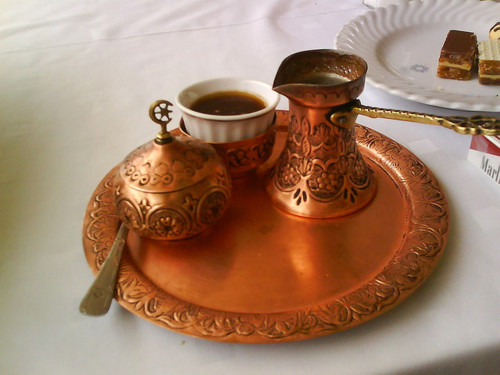
About coffee and its role in the traditional life through social but also economic aspects of Bosnia and Herzegovina we could write dozens of chapters or even a whole book. In the life of the Bosnian folk, drinking of coffee is an everyday ritual which carries in itself a strong social effect; over coffee people socialise, meet, bring mutual conclusions or business decisions but also rest and enjoy. The term "bake coffee/make coffee" clearly states that the Bosnian folk have their own, original way of preparing homemade Bosnian coffee. The preparation itself is a tradition connected to the entire ceremony which clearly alludes to the desire to enjoy or kahvendisanjem, in this beverage that invites people across the globe for socialisation, discussions and rest.
-"Let's go for coffee" or "Come over for coffee", is usually an invitation for a meeting and chat. We could say that coffee in Bosnia has a connecting role, bringing them closer to each other, nurturing friendship and love. It always calls for a dialogue. A pack of coffee and sugar is always brought over when one visits an elder person or someone who is dear to us. With that small gesture of affection we show respect towards an older person or a dear friend. Coffee is also one of the symbols of Ramadan since all of those who fast drink coffee first after their fast. Usually the coffee is drank first and only then one has dinner or iftar. Sehur is also ended with coffee drinking, a meal consumed before dawn, before fast.
About the popularity of this hot refreshing oriental beverage and attention which is dedicated by Bosnian people to the entire ceremony of preparation and drinking is best described by the description of the kitchen utensils used for making coffee. Therefore let us begin from the vessels which was in the past one of the irreplaceable vessels for coffee preparation - namely ibrik (ewer), about which Tvrtko Kanaet in his book Podveležje I podveležci writes the following: "It's a larger dish used to heat the water for coffee. The lower part is called dib and it is very protruded. It has a handle and a lid. There are large ones, which can carry 2 to 3 litres, especially among the richer households. It is always close to the fire. It contains hot water just for the preparation of coffee. Instead of water it is also used to heat up milk which is added to coffee. The coffee isn't "made" in the ibrik, but in a Džezva or Dževzi (coffee pot). It's cylindrical, near the bottom its wider and on top it has a bracket with a groove, which is used to pour coffee, and a handle which is bent at the end or expanded and beautified with ornaments. Along with the coffee pot, in which one "prepares" or "makes" coffee there is also a šerbetnjak of coffee, after the first cups have been filled. The size is measured by the number of cups which a coffee pot contains. Cup holders can be found in a small number i.e. zarfovi made out of copper decorated with ornaments. There is also a coffee grinder, coffee and sugar box with a lid. As a rule the grinder and boxes are decorated, even with the simplest ornaments. We should also add a round, cylindrical coffee maker (dolaf)."
Until the advent of the grinder the baked coffee beans were beaten (or crushed) exclusively in a dibek. It is interesting to note that in Bosnia and Herzegovina the coffee is "baked" not "cooked", and that same verb in its entirety was used by the Turks. Only since 1878 since the Austrian occupation the term "cook coffee" can be heard. Today the term "pristaviti kahvu (put on coffee)" is also established.
Preparation of Bosnian coffee
Raw coffee is usually baked in a casserole inside an oven at 200 degrees until the beans attain their characteristic brown colour. After that the casserole with the beans is taken out and left to cool. In order for the coffee to be as tasty as possible, the beans are ground in a hand grinder just before the preparation i.e. when one wants to drink coffee. In the ibrik (pot) the water is placed to boil which must not be brought to a boiling point, it must be removed from fire as soon as the first bubbles appear, which is a last phase before it boils. In the coffee pot one puts ground coffee and places it on fire, stirring so it doesn't burn. As soon as its recognizable fragrance is felt one pours water in the coffee pot and is stirred until it boils.
After the coffee is removed from fire a small amount of water is poured in the coffee pot "a few drops", for the sediment (or teljiva from the Turkish word telva) to lower to the bottom. Then it is poured into coffee cups which usually has a cube of sugar next to it or a Turkish delight. For a better sense and enjoyment of the aroma before drinking coffee one drinks a glass of water "to clear one's throat".
Coffee isn't traditionally drunk quickly, but slowly, to enjoy in it or kahvendiše. Older Bosnian people had a custom to place a dried carnation in the beans of coffee (Caryophyllus aromaticus Thunb.) and ground together in order for the beverage to have a stronger aroma and smell. For the Bosnian folk coffee is first of all a symbol of welcome and hospitality as evidenced by the traditional way of serving coffee during which, for the inhabitants of the household there is always an extra cup ready if an unexpected guest arrives (musafir). For every person which unexpectedly arrives while the inhabitants are drinking coffee it is said that they come "sa nafakom" i.e. with luck. With this we can conclude that coffee among the Bosnian people is a symbol of luck.
The magic of coffee
As we already mentioned coffee in Bosnia is prepared in a special way, specific to this country, and this description isn't only mentioned as a way of introduction to the preparation methods, but it is a necessary information in order to present the ancient ritual which is still today practiced by many Bosnian people in order to calm the tensions in marriage and in the family.
When there is tension in a marriage for some time among the partners followed by smaller or larger disputes, the woman undertakes the ritual of annulling negative energy. An empty džezva is heated on the stove and then removed and covered with a small saucer and left like that for three minutes. Coffee is then prepared in the above described way in it, and both partners drink this coffee. In the same way, it is believed that each džezva that is in the house needs to be covered in order to stop the entrance of negative energy inside a house or family.
And according to the belief of Bosnian witches coffee has magical powers which can purify each home from the negative energy and return the harmony. It is sufficient to at least once a month throw some ground coffee and sugar onto a heated stove and leave it for a few minutes to spread its fragrance around the house. After half an hour one can open the window in order for the negative energy to leave the house along with the fragrance.
Coffee and folk belief
Among the Bosnian there are dozens of superstitions about coffee, and these are just some of them:
You shouldn't pour coffee over your hand (on the right side) - your stomach will ache.
If the baked coffee beans crackle in the box, it is believed that guests will arrive soon.
When the coffee oozes out of the coffee pot on the stove - it is believed that there will be a material gain.
It is said for a woman that drinks hot coffee that she isn't afraid of her husband.
A woman which likes to drink the sediment from coffee will marry a rich man.
If the woman often makes the coffee in such a way that it oozes on the stove is a sign that her husband loves her a lot.
To dream of coffee - worrying, if you dream of drinking coffee with others - you will worry for no reason.
When the foam forms a circle then the one who gets that cup can await some sort of gain, etc.
see: http://kazandzijskaradnjamanufaktura.blogger.ba/
Aug 26, 2013
PEKSIMETI
Ingredients
1 kg flour
500 ml yoghurt
2 eggs
12 g dried yeast
Stir while gradually adding water.
The dough should be solid but wet and sticky to
touch.
Spread some flour onto a chopping board and put dough on it.
Cover the dough in flour so that it does not stick to your fingers while you cut
it into finger shaped pieces (size: 4x4x15cm roughly).
Fry the dough fingers in oil until golden brown and serve immediately with a selection
of mild cheeses and dips.
Aug 20, 2013
Flowers that smell like sorrow
Bosnian lily (Lilium bosniacum) is a flower of Bosnia and Bosnian people. Extraordinarily beautiful flower, dignified, all in golden-yellow color it proudly keeps its loftiness and regal posture while its red stamen symbolize blood of the Bosnian man, which was often shed because of the enemies of this country. The Bosnian lily became a symbol for the suffering of Bosnian people during the aggression on Bosnia and Herzegovina from 1992 to 1995. In a tragic song it is mentioned that a lily each year on July 11th changes its fragrance and that day it smells like sorrow and pain. That day from the lily the blood drips on the sacred Bosnian land on which the dead bodies of murdered men, women and children of Srebrenica, Sarajevo, Žepa, Zvornik, Bijeljina, Foča, Višegrad, Prijedor, etc. lay.
Aug 6, 2013
Jul 18, 2013
How to steal a birthmark from someone's face?
A birthmark in Bosnia has always been considered a pretty accessory on the body, especially if it was located on a face of a woman. Located near the eyes, the birthmark would make the woman prettier and more attractive and gave her a note of mysticism. In the case of numerous birthmarks on the face or one large birthmark located on the nose or the chin, then it created an opposite effect and made the woman uglier and unattractive.
Since the old times, birthmarks were given magical properties and it was believed that a person born with a birthmark, especially the one with red colour, has an immunity on the effects of black magic. Besides being a blessing , the birthmark can also be a sign of god's punishment for sins. Namely, if the pregnant woman steals something, it is believed that it will be revealed once the baby is born since on the part of the body which she touched after the theft a birthmark will be present on the baby's body at the exact same spot.
A small dark birthmark was since the old days a coveted accessory, especially on the right cheek of a woman. That's why a large number of pregnant women use the state that they are in to steal something small and black from the house that they visit, in order for her child, especially if it is a female, to have the coveted beauty mark on her face. Usually a grain of pepper was chosen as the object that the pregnant woman would steal since it resembled the beauty mark. Immediately after stealing the grain, the pregnant woman would touch her right cheek, close to her eye.
Besides appearing as a form of punishment or intervention of a pregnant woman, the birthmark can also appear on the body as a result of someone's ill intent towards him/her. When a pregnant woman visits a house, her baby is in danger of falling prey to a magic ritual. While the pregnant woman is walking away from the house, a person that wishes ill intent towards her future child, takes a hot coal and throws it after the pregnant woman, without her noticing it, and touches a party of body that he wants the baby to have a nasty birthmark.
According to folk belief a birthmark can be stolen from someone's face?! We're not talking about a plain theft but one done with the help of magic. The conditions for performing this spell are simple, it is necessary for the person whose birthmark one wants to steal to be asleep. The thief takes a warm piece of bread, brakes it in half and brings it close to the birthmark so that the vapour from the fresh bread can cover the birthmark. One needs to hold the bread in place for several minutes close to the face taking care not to wake the individual. If the person wakes up the ritual will fail. However if it succeeds the person eats that bread and soon the birthmark will appear on their face and disappear from the face of the victim. After that, it is believed that the person which had their birthmark stolen will die shortly after the ritual, that's why this ritual was always criticized and classified as a ritual of banned black magic.
Jul 15, 2013
THE GARDEN OF HAZRAT HAVA
The use of herbs for medicinal purposes is the oldest form of medicine. The cognition about the medical properties of individual herbs the Bosnian people reached through an empirical method, following particular animals, such as cats and dogs, which would eat an herb when they were sick or injured. In the same manner, humans would use a homeopathic method to compare the shape and colour of a plant with that of a human organ and based on that they reached a conclusion that since the plant corresponds to the organ it must have a positive effect on it.
The knowledge about medical and magic potential of herbs was revealed to individuals by faeries, as the legends claim. Dozens of folk songs speak about the verses that the faeries would utter in order to reveal the medical power of individual herbs. Besides that, one would come across information through magical rituals. One of them is the one of Illyrian descent when one would catch and kill a snake inside a forest and roast her until she turned into ash. That ash would be collected and gathered inside a glass. A person would take that glass and go to the part of the forest where the roosters and human voices couldn't be heard and would place some of that ash under his tongue. Apparently, at that moment the senses of that person would sharpen and that person would be connected with the nature bringing his consciousness in a state of trance. At that moment the person could hear and understand the voices of plants and trees around him and communicate with them.
Since the woman received the role of a mother and someone who takes care of the health of the children and family, from the old days, it is then logical that female deities were more present in those parts of healing where divine power and strength were called forth. When we analyze the list of medicinal herbs we can easily see that most names have a female connotation, which is another verification of the interconnectedness of the female sex and the plant world.
This connection can be seen in the short formula which is still today uttered by numerous stravarke while picking herbs which they intend on using as a magical item or an instrument for concocting a tea or medicine. While picking a specific plant the stravarka utters this formula which is followed by a rhyme in its original form: "I cull this plant from the garden of hazreti Hava (Eve), so that it can be a medicine and of benefit to me as it was to her." As we see from the above in herbal treatments the magic of words is inseparable from the process, the magic is constructed out of formulas of a short content called basme and formulas of a longer content called bajalice. Both of them are a key
component of the magical medicine in whose medicine the rhetorical power of the word is stressed.
Also in love magic a lot of attention is given to the use of specific herbs for which it is known to be a medicine for a "frozen heart". According to the rules of Bosnian witchcraft it is specifically culled between sunsets until midnight, on the eve of Friday, during the new moon.
An ideal example of such practice is the culling of milogled (asarurn europaeum) for whom there is a rule that it can be dug inside a forest with bloody hands on the first Friday of the new moon. Second powerful love herb is the mysterious "fairy grass" (Seseli rigidum?) which can only be found if you place a silver coin on the ground next to a spring. After that a witch would step aside and wait in hiding until the curious faeries show up drawn by the shinny object. At the place where they show up, after they have satisfied their curiosity regarding the silver coin they disappear, one should dig there since the root of fairy grass can be found there. Both roots should be carried on one's naked chest.
fairy grass
Herbs for magic but also for healing is infrequently grown in the gardens if the witches since they believe that the largest magic capacity can be found in "wild" grown (from God) plants especially if it grows in hard to reach places next to a river or a creek. Particularly amazing power is possessed by forest herbs, especially if there is a creek flowing through the forest. In the old Bosnian legends the faeries live inside the forests, and among them the famous Bosnian fairy, with whose song and dance all of the vegetation swells and grows and in special cycles it gains magical powers.
Subscribe to:
Posts (Atom)