Historically coffee stems from the kingdom of Kaffa in Ethiopia, from where it gained its name. In one of the oldest legends about coffee a certain shepherd Khalid is mentioned who after watching how sprightly his goats were after they have eaten the fruits from the bush of coffee, he decided to consume them himself. Since he noticed a similar effect he spread the news to all his people in the tribe about a magical plant and its fruit and the others also started consuming it.

The biggest merit for the popularity of coffee and its overall acceptance in the world is owed to the Arabs. They called it gahva which could be translated as "potable juice" and that name came from the Turks into Bosnia. In Arabia coffee was initially used as a remedy which is witnessed by Rhazes, an Arabian philosopher from the ninths century, who wrote that coffee cured sciatica. A few centuries later a few other medical merits were added to coffee and it was claimed that it strengthened the organism, had a positive effect on skin, that it cleans the skin and refreshes it.
Kahvendisanje
About coffee and its role in the traditional life through social but also economic aspects of Bosnia and Herzegovina we could write dozens of chapters or even a whole book. In the life of the Bosnian folk, drinking of coffee is an everyday ritual which carries in itself a strong social effect; over coffee people socialise, meet, bring mutual conclusions or business decisions but also rest and enjoy. The term "bake coffee/make coffee" clearly states that the Bosnian folk have their own, original way of preparing homemade Bosnian coffee. The preparation itself is a tradition connected to the entire ceremony which clearly alludes to the desire to enjoy or kahvendisanjem, in this beverage that invites people across the globe for socialisation, discussions and rest.
-"Let's go for coffee" or "Come over for coffee", is usually an invitation for a meeting and chat. We could say that coffee in Bosnia has a connecting role, bringing them closer to each other, nurturing friendship and love. It always calls for a dialogue. A pack of coffee and sugar is always brought over when one visits an elder person or someone who is dear to us. With that small gesture of affection we show respect towards an older person or a dear friend. Coffee is also one of the symbols of Ramadan since all of those who fast drink coffee first after their fast. Usually the coffee is drank first and only then one has dinner or iftar. Sehur is also ended with coffee drinking, a meal consumed before dawn, before fast.
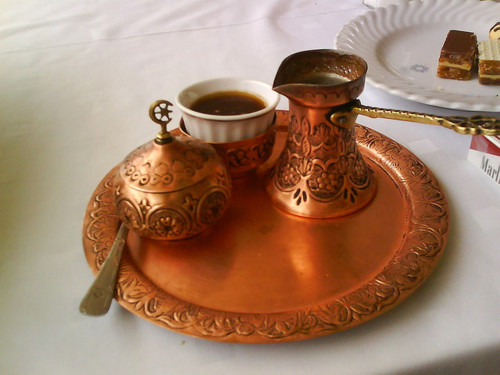
About the popularity of this hot refreshing oriental beverage and attention which is dedicated by Bosnian people to the entire ceremony of preparation and drinking is best described by the description of the kitchen utensils used for making coffee. Therefore let us begin from the vessels which was in the past one of the irreplaceable vessels for coffee preparation - namely ibrik (ewer), about which Tvrtko Kanaet in his book Podveležje I podveležci writes the following: "It's a larger dish used to heat the water for coffee. The lower part is called dib and it is very protruded. It has a handle and a lid. There are large ones, which can carry 2 to 3 litres, especially among the richer households. It is always close to the fire. It contains hot water just for the preparation of coffee. Instead of water it is also used to heat up milk which is added to coffee. The coffee isn't "made" in the ibrik, but in a Džezva or Dževzi (coffee pot). It's cylindrical, near the bottom its wider and on top it has a bracket with a groove, which is used to pour coffee, and a handle which is bent at the end or expanded and beautified with ornaments. Along with the coffee pot, in which one "prepares" or "makes" coffee there is also a šerbetnjak of coffee, after the first cups have been filled. The size is measured by the number of cups which a coffee pot contains. Cup holders can be found in a small number i.e. zarfovi made out of copper decorated with ornaments. There is also a coffee grinder, coffee and sugar box with a lid. As a rule the grinder and boxes are decorated, even with the simplest ornaments. We should also add a round, cylindrical coffee maker (dolaf)."
Until the advent of the grinder the baked coffee beans were beaten (or crushed) exclusively in a dibek. It is interesting to note that in Bosnia and Herzegovina the coffee is "baked" not "cooked", and that same verb in its entirety was used by the Turks. Only since 1878 since the Austrian occupation the term "cook coffee" can be heard. Today the term "pristaviti kahvu (put on coffee)" is also established.

Preparation of Bosnian coffee
Raw coffee is usually baked in a casserole inside an oven at 200 degrees until the beans attain their characteristic brown colour. After that the casserole with the beans is taken out and left to cool. In order for the coffee to be as tasty as possible, the beans are ground in a hand grinder just before the preparation i.e. when one wants to drink coffee. In the ibrik (pot) the water is placed to boil which must not be brought to a boiling point, it must be removed from fire as soon as the first bubbles appear, which is a last phase before it boils. In the coffee pot one puts ground coffee and places it on fire, stirring so it doesn't burn. As soon as its recognizable fragrance is felt one pours water in the coffee pot and is stirred until it boils.
After the coffee is removed from fire a small amount of water is poured in the coffee pot "a few drops", for the sediment (or teljiva from the Turkish word telva) to lower to the bottom. Then it is poured into coffee cups which usually has a cube of sugar next to it or a Turkish delight. For a better sense and enjoyment of the aroma before drinking coffee one drinks a glass of water "to clear one's throat".
Coffee isn't traditionally drunk quickly, but slowly, to enjoy in it or kahvendiše. Older Bosnian people had a custom to place a dried carnation in the beans of coffee (Caryophyllus aromaticus Thunb.) and ground together in order for the beverage to have a stronger aroma and smell. For the Bosnian folk coffee is first of all a symbol of welcome and hospitality as evidenced by the traditional way of serving coffee during which, for the inhabitants of the household there is always an extra cup ready if an unexpected guest arrives (musafir). For every person which unexpectedly arrives while the inhabitants are drinking coffee it is said that they come "sa nafakom" i.e. with luck. With this we can conclude that coffee among the Bosnian people is a symbol of luck.
The magic of coffee
As we already mentioned coffee in Bosnia is prepared in a special way, specific to this country, and this description isn't only mentioned as a way of introduction to the preparation methods, but it is a necessary information in order to present the ancient ritual which is still today practiced by many Bosnian people in order to calm the tensions in marriage and in the family.
When there is tension in a marriage for some time among the partners followed by smaller or larger disputes, the woman undertakes the ritual of annulling negative energy. An empty džezva is heated on the stove and then removed and covered with a small saucer and left like that for three minutes. Coffee is then prepared in the above described way in it, and both partners drink this coffee. In the same way, it is believed that each džezva that is in the house needs to be covered in order to stop the entrance of negative energy inside a house or family.
And according to the belief of Bosnian witches coffee has magical powers which can purify each home from the negative energy and return the harmony. It is sufficient to at least once a month throw some ground coffee and sugar onto a heated stove and leave it for a few minutes to spread its fragrance around the house. After half an hour one can open the window in order for the negative energy to leave the house along with the fragrance.

Coffee and folk belief
Among the Bosnian there are dozens of superstitions about coffee, and these are just some of them:
You shouldn't pour coffee over your hand (on the right side) - your stomach will ache.
If the baked coffee beans crackle in the box, it is believed that guests will arrive soon.
When the coffee oozes out of the coffee pot on the stove - it is believed that there will be a material gain.
It is said for a woman that drinks hot coffee that she isn't afraid of her husband.
A woman which likes to drink the sediment from coffee will marry a rich man.
If the woman often makes the coffee in such a way that it oozes on the stove is a sign that her husband loves her a lot.
To dream of coffee - worrying, if you dream of drinking coffee with others - you will worry for no reason.
When the foam forms a circle then the one who gets that cup can await some sort of gain, etc.
see: http://kazandzijskaradnjamanufaktura.blogger.ba/
see: http://kazandzijskaradnjamanufaktura.blogger.ba/


